
[Published: July 12, 2026 | Last updated: July 12, 2026] | 9 min read
TL;DR
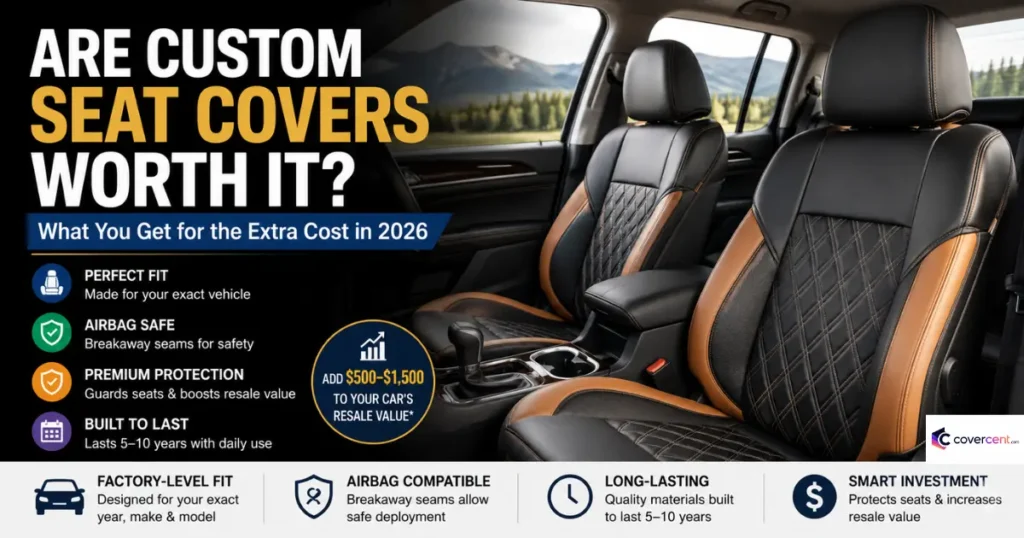
- Yes, custom seat covers are worth it if you plan to keep your car more than a year, have side airbags, or want a factory-level fit – the exact match protects resale value and avoids safety issues that universal covers can cause.
- Custom-fit covers typically cost $190 to $450 for a full set, versus $50 to $150 for universal covers (Seat Cover Solutions, 2024).
- A leather-look custom interior can add $500 to $1,500 back to your car’s resale value (CalTrend, 2026).
- Quality custom covers last 5 to 10 years; universal covers often need replacing within a year because they shift and wear at the fold points (CalTrend, 2026).
- Skip custom covers only if you’re driving a short-term rental, a cargo vehicle without side airbags, or you’re planning to sell within the next few months.
What Are Custom Seat Covers, and Are They Worth the Price?
Custom seat covers are worth the price for most drivers who keep a vehicle longer than a year. They’re patterned to your car’s exact year, make, model, and trim, so the seams, airbag cutouts, and headrest openings line up with the factory design (CalTrend, 2020).
That precision is the entire value proposition. A universal cover is one shape stretched across hundreds of different seats. A custom cover is built from a pattern traced to your specific seat. The difference shows up in three places: how it looks, how it protects your airbags, and how long it survives daily use.
If your seats have side-impact airbags, integrated seatbelts, or a split-fold rear bench, custom covers aren’t just a style upgrade. They’re the version built to work with those features without blocking them.
How Custom Seat Covers Are Made and Fitted
A custom seat cover starts with a pattern, not a bolt of fabric. Manufacturers trace the panel shapes from the exact seat dimensions of a specific vehicle, then cut and stitch each panel to match the contours, bolsters, and mounting points of that seat (Coverado, 2026).
The process generally follows three stages:
- Pattern matching. You enter your vehicle’s year, make, model, and trim. The manufacturer pulls the corresponding pattern from their library.
- Panel construction. Each seat gets a front panel, back panel, and side panels cut to the seat’s actual shape, with cutouts for armrests, LATCH anchors, and airbag seams built in.
- Airbag-safe stitching. On seats with side airbags, the seam over the airbag zone uses a breakaway thread designed to tear open on deployment instead of blocking it (nwseatcovers.com).
Installation for most custom sets takes 45 to 90 minutes and uses a strap-and-buckle system – no tools, no seat removal (CalTrend, 2026).
Custom vs. Universal Seat Covers: Where the Money Actually Goes
The direct answer: the extra cost pays for fit precision. Custom covers cost more upfront because every panel is cut for one specific seat shape instead of a generic size range.
| Factor | Universal Covers | Custom-Fit Covers |
|---|---|---|
| Price (full set) | $50-$150 | $190-$450 |
| Airbag compatibility | Not guaranteed | Built-in breakaway seams |
| Fit | Loose, bunches at bolsters | Matches factory seam lines |
| Typical lifespan | Under 1 year with regular use | 5-10 years |
| Resale value impact | Minimal | Can add $500-$1,500 (leather-look) |
Universal covers rely on elastic hems and hook straps to span “most” seats, which means they bunch and shift on anything with sculpted bolsters or a split-fold bench (Coverado, 2026). Custom covers use panel-specific cuts that hold their shape through thousands of entry and exit cycles.
Are Custom Seat Covers Safer Than Universal Ones?
Custom covers are the safer choice on any vehicle with side-impact airbags. Most seats built in the last decade have an airbag mounted in the outboard bolster that deploys through a seam in the original upholstery (Seat Cover Solutions, 2026).
A custom cover replicates that seam in the same location, sewn with a breakaway thread engineered to split open under deployment pressure. A universal cover has no such seam – it’s just fabric sitting over the airbag zone, with no guaranteed break point (nwseatcovers.com).
If you’re unsure whether your seats have side airbags, check your owner’s manual or look for a small airbag label stitched into the outboard seat bolster before buying any cover, universal or custom.
How Long Do Custom Seat Covers Actually Last?
Custom seat covers typically last 5 to 10 years depending on material and how often the vehicle is used (CalTrend, 2026). That range holds up because the tight, panel-specific fit means less friction and stretching at the seams compared to a universal cover.
Material affects lifespan directly:
- Neoprene: holds tension well and resists water intrusion at the seams, common in vehicles used for outdoor activities.
- Canvas: built for abrasion resistance, favored in work trucks and utility vehicles.
- Leatherette/faux leather: resists cracking better than genuine leather since it doesn’t dry out under UV exposure the way animal hide does (CalTrend, 2026).
- Genuine leather: looks premium but needs regular conditioning to avoid cracking over time.
Universal covers, by contrast, often need replacing within a year of regular use because constant sliding abrades both the cover fabric and the original upholstery underneath it (Coverado, 2026).
Common Mistakes to Avoid When Buying Custom Seat Covers
- Skipping the airbag check: Buying a cover without confirming side-airbag compatibility can block deployment in a crash. Check your vehicle’s airbag configuration before ordering.
- Assuming “semi-custom” means custom-fit: Semi-custom covers reuse patterns across several similar vehicles, which limits precision. Confirm the listing matches your exact year, make, model, and trim.
- Ignoring seat features: Heated, ventilated, or power-adjustable seats need covers rated to work with those features. A cover that blocks airflow channels can affect heating and cooling performance.
- Choosing price over installation time: The cheapest custom option isn’t always the best value if it takes hours to install correctly. Compare installation time alongside price and material.
Frequently Asked Questions About Custom Seat Covers
Are custom seat covers worth it?
Yes, if you’re keeping your vehicle more than a year or your seats have side airbags. The exact fit protects your factory upholstery, works safely with airbag deployment, and typically lasts 5 to 10 years, which offsets the higher upfront cost.
How much do custom seat covers cost?
A full custom-fit set generally runs $190 to $450, depending on material and vehicle size (Seat Cover Solutions, 2024). Larger vehicles like trucks and SUVs cost more because they require more fabric and more complex panel cuts.
Do custom seat covers work with side airbags?
Reputable custom-fit brands build a breakaway seam into the airbag zone that matches the factory seam location, allowing the airbag to deploy without obstruction. Always confirm airbag compatibility with the manufacturer before purchase, especially on vehicles built in the last decade.
What is the difference between custom and universal seat covers?
Custom covers are patterned to your vehicle’s exact year, make, model, and trim, so seams and cutouts match the factory layout. Universal covers use one stretchable pattern meant to loosely fit many different vehicles, which often results in bunching, shifting, and gaps around airbags.
Do custom seat covers increase resale value?
A leather-look custom interior can add $500 to $1,500 to a vehicle’s resale value, mainly because it makes the car easier to sell and signals to buyers that it was well maintained (CalTrend, 2026). Protecting the original upholstery underneath also matters if you plan to remove the covers before selling.
Key Takeaways
- Custom seat covers cost more upfront but pay off in fit, airbag safety, and durability over a 5-to-10-year lifespan.
- Universal covers make sense only for short-term use, older vehicles without side airbags, or a tight budget.
- Always confirm your seat’s airbag configuration before buying any cover.
- If you’re keeping the car for a while or want to protect resale value, custom is the better buy.
Sources referenced:
- CalTrend – How Much Does It Cost to Put Leather Seats in a Car? (2026): https://www.caltrend.com/how-much-does-it-cost-to-put-leather-seats-in-a-car/

Leave a Reply