
[Published: July 16, 2026 | Last updated: July 16, 2026]
TL;DR
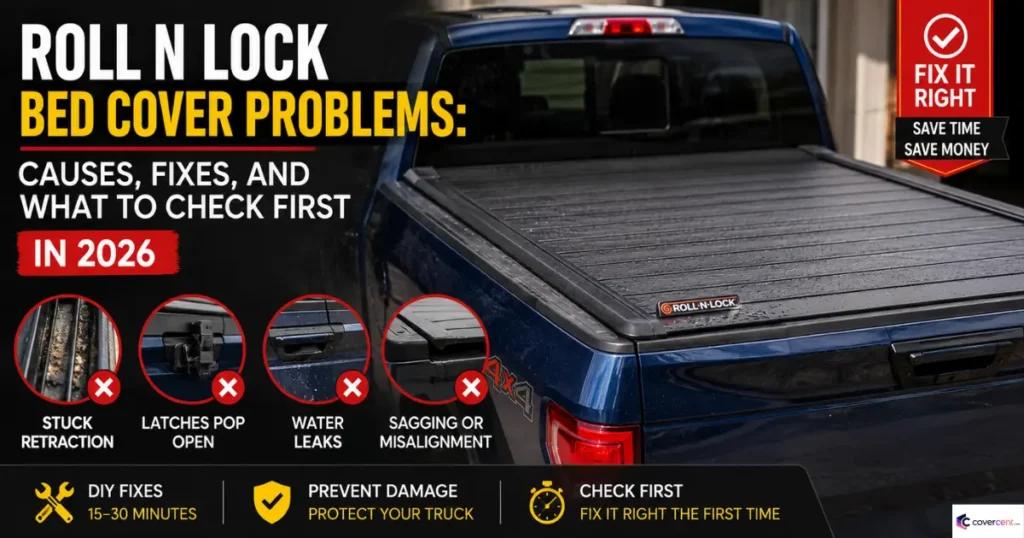
- The most common Roll N Lock issues are stuck retraction, latches that pop open while driving, water leaks near the tailgate, and sagging from misalignment or overloading.
- Retraction problems are usually track debris or a dry roller system – clean the tracks and apply a silicone lubricant before assuming a part is broken.
- Water intrusion happens because Roll N Lock covers are water-resistant, not waterproof; gaps at the tailgate and side rails are the usual entry points.
- Most fixes take 15-30 minutes with basic tools: realigning clamps, replacing weatherstrip, or clearing drain channels.
- If a cover was installed with the wrong rail-cap configuration, no amount of adjustment will fully fix it – the dealer needs to swap the part.
What Are the Most Common Roll N Lock Bed Cover Problems?
The four problems Roll N Lock owners report most are a cover that will not retract smoothly, a latch that will not stay locked, water getting into the bed, and the cover sagging in the middle. Most of these trace back to two root causes: dirt or corrosion in the moving parts, or a cover that was not aligned correctly at installation.
None of these problems are unique to one truck model. They show up across the A-Series, E-Series, and M-Series lines because the covers share the same rail-and-roller design.
Why Won’t My Roll N Lock Cover Retract Smoothly?
A cover that sticks or has to be pushed instead of rolling on its own is almost always caused by debris in the side rails or a dry roller mechanism. Dirt, sand, and road grime build up in the tracks over time and create drag exactly where the cover needs to glide.
Start with these steps in order:
- Clean both rails. Use a soft brush to remove dirt and debris built up along the slats and rail channels (TonneauGuide, 2025).
- Lubricate the rollers. Apply a silicone spray – not grease, which attracts more dirt – to both sides of the rollers along the full length of the track (MechanicsPick, 2023).
- Check the torsion spring. An over-tightened tensioner or uneven cargo loading can also stop the cover from rolling smoothly. If lubrication does not solve it, this is the next thing to inspect (MechanicsPick, 2023).
- Rule out a bad install. If the cover is new and still sticks after cleaning and lubricating, the housing bracket may have been installed incorrectly. Take it back to the dealer rather than forcing it.
Why Does the Latch Keep Popping Open While Driving?
An unlatching cover is typically caused by sagging rails, a misaligned tailgate bracket, or a worn latch mechanism that no longer catches securely. This is the complaint that shows up most often in long-term owner reports, and it is also the most safety-relevant one.
One Diesel Place forum thread documents a cover that came unlatched on the passenger side within a mile of driving, even after the dealer replaced both rails twice. The eventual fix was a full cover swap, because the dealer had originally installed a version built for trucks without rail caps on a truck that had them (Diesel Place, 2007).
Before assuming the whole unit is defective, check these first:
- Bumper blocks at the tailgate latch. Worn or missing rubber blocks stop the tailgate from centering on the cover (TonneauCovers.me, 2025).
- Rail alignment. Loosen the mounting clamps and slide the cover side to side until it sits level on both rails.
- Rail-cap compatibility. Roll N Lock sells separate covers for trucks with and without factory rail caps. Installing the wrong one causes chronic latch problems that adjustment alone cannot fix (CherishYourCar, 2025).
Why Is Water Getting Into the Truck Bed?
Roll N Lock covers are water-resistant, not fully waterproof, so some moisture can reach the bed through gaps at the tailgate and side rails during heavy rain (TonneauCovers.me, 2025). The goal with troubleshooting is to minimize how much gets through, not to expect a bone-dry bed in every downpour.
Find the leak before you fix it:
- Hose down the closed cover and check for wet spots along the sides, front, and back.
- Slide a dollar bill between the cover and the bed rail. If it slides in with no resistance, the seal needs adjusting (TonneauGuide, 2025).
Once you know where water is entering, these fixes cover most cases:
| Leak Source | Fix |
|---|---|
| Worn or torn weatherstrip | Replace the rubber strip around the cover edges (available at auto parts stores) |
| Clogged drain tubes | Clear built-in drain channels with compressed air or a pipe cleaner (TonneauCovers.me, 2025) |
| Loose clamps | Tighten mounting clamps so the cover sits snugly against the bed edges |
| Gap at tailgate hinge | Add an aftermarket tailgate seal strip |
Why Is My Cover Sagging in the Middle?
A cover that bows or droops near the tailgate is caused by exceeding the rated weight capacity or by one side rail sitting lower than the other. Roll N Lock covers have a published load limit, and going over it – even by a few hundred pounds – can cause the cover to buckle (TonneauCovers.me, 2025).
To fix it:
- Unlock the cover and slowly raise and lower it while watching for binding or one side dropping first.
- Loosen the mounting clamps and shift the cover until both sides sit level.
- Stop stacking cargo directly on the closed cover. If you regularly haul heavy loads, look at a higher-capacity model instead of pushing the current one past its limit.
Common Mistakes That Make These Problems Worse
- Using grease instead of silicone spray on the rails. Grease attracts more dirt, which recreates the sticking problem within weeks.
- Ignoring a slow leak. Small amounts of water left standing in the bed accelerate rust on fasteners and the roller housing (MechanicsPick, 2023).
- Skipping the rail-cap check before ordering. Roll N Lock makes separate covers for trucks with and without rail caps. Ordering the wrong one leads to a latch problem that no amount of DIY adjustment will fully resolve (CherishYourCar, 2025).
- Piling cargo on a closed cover. Even short-term weight beyond the rated limit can cause sagging that does not fully reverse.
Frequently Asked Questions About Roll N Lock Bed Cover Problems
What is the most common Roll N Lock bed cover problem?
Retraction issues are the most frequently reported problem. A cover that sticks or needs a push to roll is usually caused by dirt in the tracks or a dry roller system, both of which are fixable with cleaning and lubrication.
Are Roll N Lock covers actually waterproof?
No. Roll N Lock covers are water-resistant, not waterproof. Some moisture can get through gaps at the tailgate and side rails during heavy rain, though proper alignment and intact weatherstripping minimize it significantly.
Why does my Roll N Lock cover keep unlatching while I drive?
This is usually caused by sagging or misaligned rails, worn bumper blocks at the tailgate latch, or – in some cases – a cover that does not match the truck’s rail-cap configuration. Realigning the rails fixes most cases; a mismatched cover requires a replacement.
How much weight can a Roll N Lock cover hold?
Weight limits vary by series and model, so check the specification sheet for your exact cover. Exceeding the rated limit, even temporarily, is a leading cause of sagging and buckling near the center of the cover.
Can I fix Roll N Lock problems myself, or do I need a dealer?
Most common issues – dirty tracks, worn weatherstrip, misaligned clamps, clogged drains – are DIY fixes that take under 30 minutes. Installation errors, like the wrong rail-cap cover, typically require the dealer or manufacturer to resolve since they involve swapping parts, not adjusting them.
Key Takeaways
- Clean tracks and silicone lubricant solve the majority of retraction complaints.
- Latch problems point to alignment first, mismatched rail-cap covers second.
- Expect some moisture in heavy rain since these covers are water-resistant, not waterproof – focus on minimizing entry points.
- Stay under the rated weight limit to prevent sagging that alignment alone cannot fix.
Sources:

Leave a Reply