
[Published: 2026-08-05 | Last updated: 2026-08-05] | 7 min read
TL;DR
- Yes, you can legally drive with most tonneau covers partially open, but the cover must be locked or strapped down so it can’t flap, lift, or detach.
- Hard folding covers are the safest to drive partially open because their panels latch in place; soft roll-up covers usually only work fully open or fully closed, not in between.
- A partially open cover can cut fuel economy by up to 10% due to wind drag (Tonneau Covers, 2025).
- Every state requires cargo to be secured well enough that nothing can shift, slide, or fall onto the road, and violations carry real fines – $238 in California and up to $500 in some states (California Office of Traffic Safety, 2025; Pull Tarps, 2026).
- If you’re hauling something too tall to close the cover over, strap the cover down at its open point and keep speeds moderate until you can close it.
Can You Drive With a Tonneau Cover Partially Open?
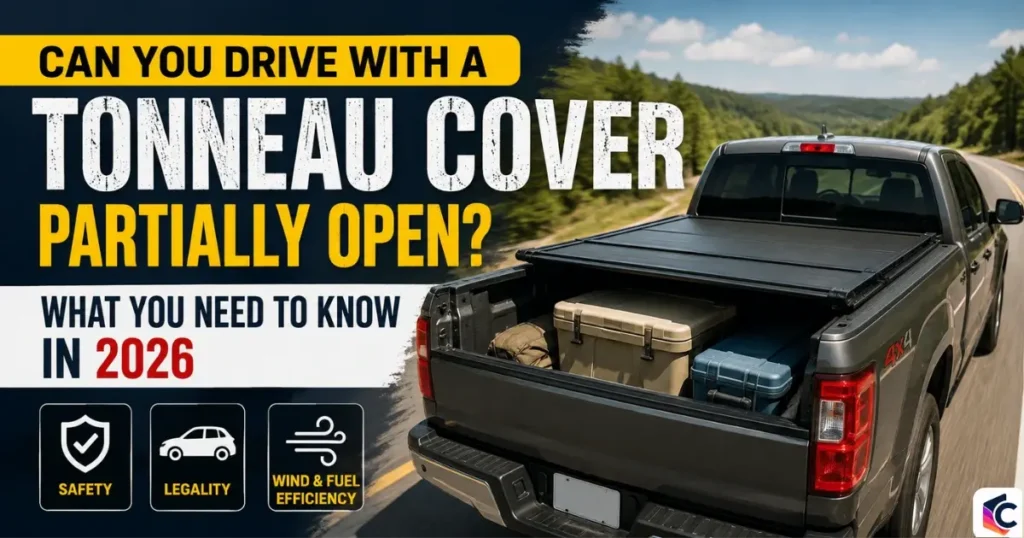
In most cases, yes. Whether it’s actually safe or practical depends entirely on what type of cover you have. A hard folding tri-fold cover, for example, has built-in latches that let you lock one or two panels up while the rest stays closed, and manufacturers generally allow this (TonneauCovers.me, 2025).
Soft roll-up and vinyl covers work differently. They typically only have two positions: fully rolled closed or fully rolled open and clipped at the front of the bed. There’s no in-between setting to strap down safely (F150lab, 2023).
The type of cover you own decides whether “partially open” is a supported feature or something you’re improvising on the fly.
How Different Tonneau Cover Types Handle Partial Opening
Not every cover is built to sit halfway open. Here’s how the main styles compare.
| Cover Type | Partial-Open Capable? | How It Locks |
|---|---|---|
| Hard tri-fold | Yes | Built-in panel latches hold folded sections in place |
| Soft tri-fold | Sometimes | Straps or clips secure folded panels, but less rigid |
| Soft roll-up | No | Only fully open (rolled and clipped) or fully closed |
| Retractable/canister | No | Retracts into a canister; no partial-lock position |
Hard covers hold their shape better at speed because the panels are rigid, which reduces flapping and wind noise compared to soft materials (MOSTPLUS, 2025).
If your cover isn’t designed for a partial-open position, forcing it open anyway – propped with cargo or held by rope – is the riskiest way to drive with one.
Safety Risks of Driving With a Partially Open Cover
The main risks are debris coming loose, wind catching the cover, and reduced rear visibility. Each one gets worse the faster you drive or the rougher the road.
Cargo can fly out. An unlatched or improperly braced cover leaves a gap for loose items to bounce out, especially on highway speeds or uneven pavement (Tonneau Guide, 2025).
The cover itself can detach. Wind resistance on an unsecured panel can pull it loose, and a cover coming off at speed becomes a hazard for vehicles behind you (Tonneau Guide, 2025).
Rear visibility drops. A propped-open panel or bunched-up soft cover can block part of your rearview mirror line, which matters most when merging or backing up (Tonneau Guide, 2025).
Fuel economy drops. An open cover increases drag. Drivers can see up to a 10% drop in fuel economy compared to driving with the cover fully closed (Tonneau Covers, 2025).
None of these risks rule out driving with a cover partially open. They just mean the cover needs to be locked down, not just resting open.
Is It Legal to Drive With a Tonneau Cover Partially Open?
Legality comes down to your state’s unsecured-load law, not the tonneau cover specifically. Every state requires that cargo, and anything covering it, be fastened well enough that nothing can shift, slip, or fall onto the roadway.
California Vehicle Code §2803 requires loads to be secured to prevent dropping or shifting onto the road, and officers can ticket a vehicle even if nothing has actually fallen off yet, based on the load simply looking unsecured (Ticket Snipers, 2023). Fines for unsecured loads run about $238 in California (California Office of Traffic Safety, 2025).
Utah Code §72-7-409 defines an unsecured load as cargo that isn’t sufficiently covered, confined, or fastened to prevent it from leaving the vehicle (Gunter Injury Law, 2025). Washington State fines start at $228 and can climb to $5,000 if the unsecured load causes an injury (Ladenburg Law, 2023).
The pattern across states is consistent: a partially open tonneau cover is legal as long as it’s fastened down and nothing inside the bed can escape. An open cover with loose gear underneath is where drivers get ticketed.
How to Drive Safely With a Tonneau Cover Partially Open
If you have to leave the cover partly open, usually because you’re hauling something too tall to close it over, a few habits keep the drive legal and low-risk.
- Lock or strap the open panel down. Use the cover’s built-in latch if it has one. If not, use ratchet straps rated for outdoor use, not bungee cords, which stretch and fail at highway speed.
- Secure everything under the gap separately. Tie down or box in any cargo near the open section so it can’t shift toward the opening.
- Check your mirrors before you leave. Confirm the propped section isn’t blocking your rearview sightline.
- Keep speeds moderate on the highway. Wind load increases with speed, so a cover that sits fine at 45 mph can start lifting at 70 mph.
- Recheck the strap at your first stop. Vibration loosens tie-downs faster than most drivers expect, so a five-minute check after 20-30 minutes on the road catches problems early.
Common Mistakes to Avoid
- Propping the cover with cargo instead of a proper latch: This looks secure at a stoplight but shifts the moment you hit highway speed. Use the manufacturer’s latch or a rated strap instead.
- Assuming a soft roll-up cover can sit half-open: Most soft covers are built for two positions only. Forcing a middle position stresses the material and the mounting rails.
- Skipping the local law check before a road trip: Load securement rules vary by state, and border-crossing a few states on a trip can mean different fine amounts and enforcement standards. Check the rule in the state you’re driving through, not just your home state.
Frequently Asked Questions About Driving With a Tonneau Cover Partially Open
Can you drive with a tonneau cover partially open?
Yes, for most hard folding covers, as long as the open panel is latched or strapped so it can’t lift or flap. Soft roll-up covers usually don’t support a true partial-open position.
Is it illegal to drive with a tonneau cover open?
No single law bans open tonneau covers. What’s illegal in every state is driving with cargo that isn’t secured well enough to prevent it from falling, shifting, or blowing onto the road.
Does driving with a tonneau cover open hurt gas mileage?
Yes. An open cover increases wind drag, and drivers can see fuel economy drop by as much as 10% compared to driving with the cover closed (Tonneau Covers, 2025).
Can a soft tonneau cover be driven partially open?
Generally no. Most soft roll-up and vinyl covers are built for two positions, fully closed or fully rolled open at the front of the bed, with no secure middle setting.
What happens if I get pulled over with an unsecured tonneau cover?
You can be cited under your state’s unsecured-load statute even if nothing has fallen out yet. Fines range from roughly $150 to $500 depending on the state, and can reach $5,000 if the unsecured load causes an injury (Pull Tarps, 2026; Ladenburg Law, 2023).
How fast can I drive with a tonneau cover partially open?
There’s no universal speed limit tied to this specifically, but wind load increases with speed. Keep to moderate speeds, and check the strap or latch at your first stop to make sure nothing has worked loose.
Key Takeaways
- Whether you can drive with a tonneau cover partially open depends on the cover type; hard folding covers support it, most soft covers don’t.
- The open section must be locked or strapped down, not just propped, to stay legal and safe.
- Expect a fuel economy hit and reduced rear visibility any time the cover isn’t fully closed.
- Unsecured-load fines apply in every state and can scale up sharply if the load causes an accident.

Leave a Reply