
How Are Drain Covers Made? The Casting and Fabrication Process in 2026
[Published: 19 October 2026 | Last updated: 19 October 2026] | 7 min read
TL;DR
- Most drain covers are made by sand casting: molten iron is poured into a sand mould, cooled, cleaned, coated, and tested.
- Ductile iron (iron treated to bend slightly before breaking) is used where traffic is heavy, and grey iron is used for lighter loads.
- Stainless steel, brass, and zinc covers are made by investment casting or die casting, and steel grates are often fabricated and galvanized.
- Covers are rated by load class under BS EN 124:2015, from A15 (15 kN test load) to F900 (900 kN) (Wrekin Products, 2015).
- A D400 ductile iron manhole cover with frame weighs 61 kg, while a C250 channel grate weighs 6.2 kg (EPD International, 2024).
How Are Drain Covers Made? The Short Answer
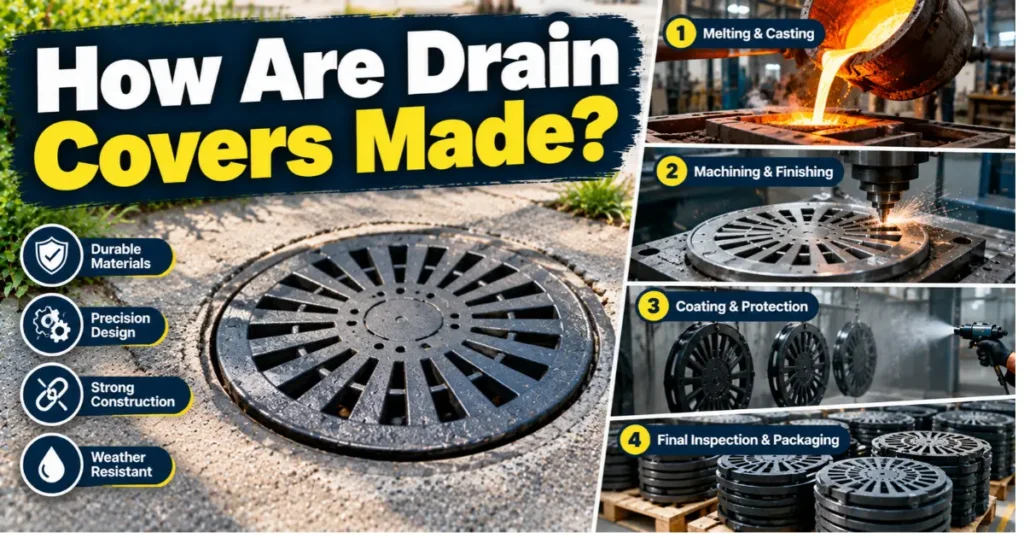
Most drain covers are made by pouring molten iron into a mould shaped like the finished cover. The mould cavity is formed from bonded sand, and once the iron cools, the sand is broken away and cleaned off the casting. This is called sand casting. duratrench
Other materials follow different routes. Stainless steel, brass, zinc, steel sheet, and composites each use their own production method, covered below.
A drain cover is the removable lid over a drain or manhole. A grate (also called a grating) is a drain cover with slots or holes that let water through.
Which Materials Are Drain Covers Made From?
Drain covers are made from grey cast iron, ductile iron, steel, stainless steel, brass, zinc, concrete, or composite materials. The material depends on the load the cover must carry and the look the buyer wants.
| Material | Typical Process | Typical Use |
|---|---|---|
| Grey cast iron | Sand casting | Pedestrian and light vehicle areas |
| Ductile iron | Sand casting plus treatment | Roads, car parks, industrial yards |
| Galvanized steel | Cutting, welding, hot-dip galvanizing | Trench drains, lighter-duty grates |
| Stainless steel | Investment casting or sheet fabrication | Kitchens, bathrooms, hygiene areas |
| Brass or zinc | Die casting plus plating | Decorative floor and shower drains |
| Composite | Moulding | Corrosion-prone or theft-prone sites |
BS EN 124 is the European standard for covers and gratings. It has parts for cast iron (EN 124-2), steel-reinforced concrete (EN 124-4), and composite materials (EN 124-5) (Underground Construction, 2015).
How Does Sand Casting Make a Cast Iron Drain Cover?
Sand casting turns a pattern into a mould, then fills the mould with molten iron. A foundry packs green sand around a pattern in a moulding box, removes the pattern, and pours molten iron into the cavity left behind. Think of pressing a cup into wet beach sand to leave a cup-shaped hole, then filling that hole. uspto
The full sequence has seven steps:
- Pattern making: A pattern is built in the exact shape of the cover, including ribs, slots, and lettering.
- Mould making: Sand is packed around the pattern in a box, then the pattern is lifted out.
- Melting: Iron is melted in a furnace. Foundry operators adjust the chemistry by changing the raw materials and additives.
- Pouring: The molten iron is poured into the sand cavity.
- Cooling and shakeout: The casting cools, and the sand is broken away.
- Finishing: Rough edges and casting seams are ground off, and the cover is cleaned.
- Coating and marking: A protective coating is applied where specified, and the cover is marked.
Each mould is destroyed when the casting is removed, so a new sand mould is made for every cover.
What Makes Ductile Iron Different From Grey Iron?
Ductile iron is treated with magnesium so its graphite forms small spheres instead of flakes, which makes the metal tougher and less brittle. Grey iron has flake graphite, which makes it strong in compression but more likely to crack under shock.
According to QYResearch (2025), ductile iron grate production starts with controlled chemistry using pig iron, scrap steel, magnesium-based spheroidizing agents, and inoculants, followed by casting, heat treatment, and anti-corrosion coating. foriio
Grey cast iron grates are governed by ASTM A48 Class 35B, while ductile iron grates are governed by ASTM A536. ASTM stands for American Society for Testing and Materials, now called ASTM International. duratrench
Ductile iron is the usual choice for heavy traffic. Decorative grates often use grey iron. Iron Age Designs, for example, makes its standard grates from recycled grey iron to ASTM A48 Class 25 or better. concretedecor
How Are Stainless Steel, Brass, and Zinc Drain Covers Made?
Brass and zinc covers are usually die cast, and stainless steel covers are usually investment cast or cut from sheet. Each route has trade-offs in cost, speed, and finish.
Die casting allows low-cost mass production of complex grate shapes in brass, zinc, and other non-ferrous metals, but needs an electroplating step to get a polished chrome-like surface. Non-ferrous means the metal contains no iron. uspto
Investment casting can form stainless steel grates directly, but it takes longer, produces lower volume, costs more in raw materials, and often leaves thicker walls that need straightening. Many stainless drain covers are therefore cut and welded from sheet instead. uspto
How Are Steel Grates Fabricated and Galvanized?
Steel grates are built from flat bars or sheet, welded or pressed into shape, and then protected against rust. They are lighter and cheaper than cast iron but carry less load.
Pressed grates can be made from zinc-galvanized sheet, steel sheet that is hot-galvanized after moulding, or stainless steel sheet. Galvanizing means coating steel with zinc to slow corrosion. google
The same source notes that cast iron grates are heavy and expensive, which is why makers use steel where the load allows (US Patent RE32248, 1987).
How Do Manufacturers Test and Classify Drain Covers?
Manufacturers test each design against a static load and assign a class from A15 to F900. The number is the test load in kilonewtons (kN), a unit of force. 100 kN is roughly 10 tonnes of force.
Class A15 covers withstand a 1.5-tonne test load, D400 covers withstand 40 tonnes, and F900 covers withstand 90 tonnes. (Wrekin Products, 2015) wrekinproducts
| Class | Test Load | Typical Location |
|---|---|---|
| A15 | 15 kN | Areas closed to vehicles |
| B125 | 125 kN | Driveways and footways |
| C250 | 250 kN | Kerbside gully tops |
| D400 | 400 kN | Heavy-duty road carriageways |
| E600 | 600 kN | High wheel-load areas |
| F900 | 900 kN | Docks and airports |
Each compliant product must carry permanent markings showing the BS EN 124 reference, the load class, the manufacturer, and the place of manufacture. (Drainfast, 2025) drainfast
How Much Does a Finished Drain Cover Weigh?
Weight depends on size and load class. One D400 ductile iron manhole cover and frame, measuring 600 x 600 mm, weighs 61 kg, and one C250 ductile iron channel grate, measuring 498 x 222 mm, weighs 6.2 kg. (EPD International, 2024) environdec
A heavier cover is harder to lift, but it stays seated under traffic. That is why road covers are cast thick and small channel grates are made thin.
Frequently Asked Questions About How Drain Covers Are Made
What is the most common way to make a drain cover?
Sand casting is the most common method for iron covers. Molten iron is poured into a sand mould, cooled, cleaned, and coated.
What is the difference between cast iron and ductile iron drain covers?
Cast iron (grey iron) has flake graphite and is strong but brittle. Ductile iron is treated with magnesium so it bends slightly before breaking, which suits heavy traffic.
What does D400 mean on a drain cover?
D400 is a load class under BS EN 124 for covers tested to 400 kN, about 40 tonnes. It is the class used for heavy-duty road carriageways.
Why are some drain covers made from stainless steel or brass?
Stainless steel resists corrosion and is easy to clean, so it is used in hygiene-sensitive areas. Brass and zinc are die-cast into decorative shapes for floor and shower drains.
Are drain covers made from recycled material?
Many are. Some iron grate makers use recycled iron as their raw material, and foundries also use scrap steel in ductile iron production.
How do I know a drain cover meets the standard?
Look for the permanent marking on the cover. It shows the BS EN 124 reference, the load class, and the manufacturer’s identification.
References
- EPD International: Ductile & Grey Iron Manhole Cover, Channel Gratings and Pipe Fittings (EPD-IES-0016507)
- Wrekin Products: Understanding BS EN 124 Groups and Classes
- Google Patents: US8211298B2, Cast Metal Article and a Method of Its Manufacture

Leave a Reply