
[Published: 14 October 2026 | Last updated: 14 October 2026] | 6 min read
TL;DR
- A drain cover is the grate, plug, or lid that sits over a drain opening. Its location depends on the drain type: at the lowest point of a shower, sink, floor, or yard.
- Indoor drain covers are in bathrooms, kitchens, laundry rooms, basements, and garages. Outdoor ones sit in driveways, patios, gutters, and along the street.
- Washing machines and dishwashers have no visible drain cover. They have a drain pump filter behind a small access panel or under the bottom rack.
- Plumbing codes require a trap under every fixture drain, so a cover always sits above a water-filled bend (International Plumbing Code, ICC, 2021).
- If the cover is on a public street, do not open it. Call your city or municipality.
What Is a Drain Cover and What Does It Do?
A drain cover is a perforated grate, flat plug, or lid placed over a drain opening. It lets water pass through while blocking hair, food scraps, leaves, and debris. It also keeps people from stepping into the opening.
Drain covers go by several names: strainer, grate, drain guard, or catch basin lid. This article uses “drain cover” for all of them.
Every cover sits above the same basic setup. Water drops through the opening, passes a curved pipe section called a trap, and continues into the main drain line. The trap holds a small amount of water that blocks sewer gas from rising back up.
Where Is the Drain Cover in a Bathroom?
In a bathroom, the drain cover is at the lowest point of the shower floor, the bottom of the tub, and the bottom of the sink basin. Shower and tub covers are flat grates or round stoppers. Sink covers are usually the small stopper or mesh strainer you see in the basin.
Check these spots in order:
- Shower floor: Look at the center of the floor or along one wall. Linear showers have a long slot drain along one edge.
- Bathtub: The cover is a stopper or strainer at the foot of the tub, below the faucet.
- Bathroom sink: The cover is the stopper in the middle of the basin. A second opening near the top is the overflow, which has its own small cover plate.
Hair collects under all three, so these are the covers you will remove most often.
Where Is the Drain Cover in a Kitchen and Laundry Room?
In a kitchen, the drain cover is the strainer basket at the bottom of each sink bowl. If you have a garbage disposal, the cover is a rubber splash guard sitting inside the disposal opening.
In a laundry room, look for a standpipe behind the washer or a floor drain nearby. A utility sink has its own strainer at the bottom of the basin.
Dishwashers do not drain through the sink cover. They connect to the disposal or a drain hose under the sink. See the appliance section below for the filter location.
Where Is the Floor Drain Cover in a Basement or Garage?
A basement or garage floor drain cover is a round or square metal grate set into the concrete floor, usually near the lowest point or beside the water heater, washer, or furnace. The floor slopes slightly toward it.
Two quick tips for finding it:
- Pour a small cup of water on the floor and watch which way it runs.
- Check near utility equipment, since plumbers place floor drains where leaks are most likely.
Some covers are held down by screws. Others lift out by hand. If the cover is rusted in place, spray penetrating oil around the edge and let it sit before you pull.
Where Is the Drain Cover Outside Your Home?
Outside, drain covers are at low points where rainwater collects: the bottom of a driveway, the center of a patio, the base of a downspout, and the edge of a street. Most are cast iron or plastic grates, and some are solid lids over a buried catch basin.
Walk the property after rain and note where water pools. Drain covers will be at or near those spots.
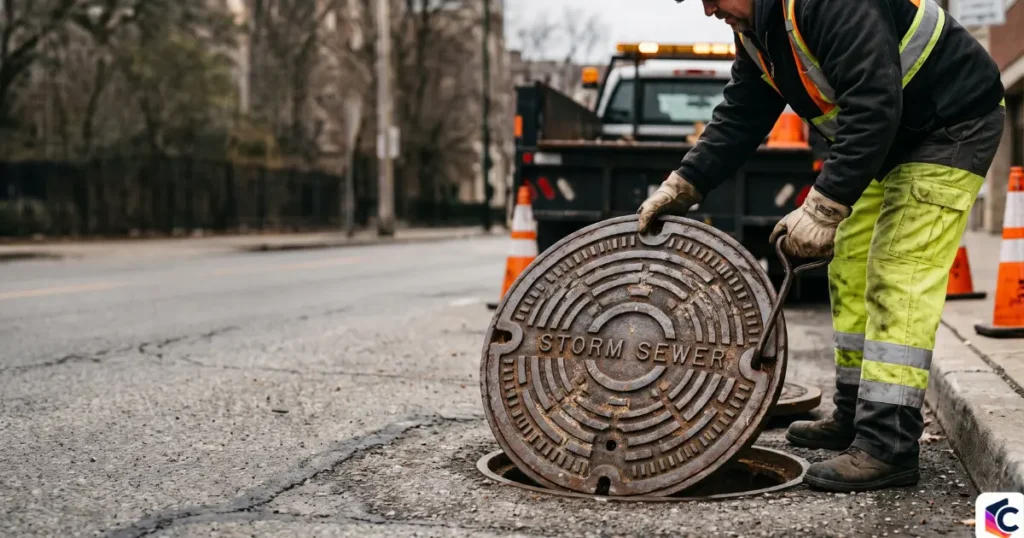
Street storm drains are different. They carry rainwater to local streams and rivers, usually without treatment (U.S. EPA, n.d.). These belong to the city. Do not remove street covers yourself. They are heavy, and removing one is often illegal. Report blocked or missing covers to your municipality.
Where Is the Drain Cover on a Washing Machine or Dishwasher?
Washing machines and dishwashers do not have a drain cover. They have a drain filter, which catches coins, lint, and debris before the pump. Where it sits depends on the model.
| Appliance | Where the filter or cover is | How to reach it |
|---|---|---|
| Front-load washer | Behind a small panel at the bottom front corner | Pop the panel open, place a shallow pan below, and unscrew the filter |
| Top-load washer | Lint filter inside the drum or agitator, if equipped | Lift it out by hand |
| Dishwasher | Bottom of the tub, under the lower rack | Twist the cylindrical filter and lift it out |
| Garbage disposal | Rubber splash guard in the sink opening | Pull it up from the sink side |
Model layouts vary. Your owner’s manual shows the exact spot.
Quick Reference: Drain Cover Locations by Room
| Drain type | Typical location | Cover style |
|---|---|---|
| Shower | Center or edge of the shower floor | Flat grate or slot cover |
| Bathtub | Foot of the tub | Stopper or strainer |
| Bathroom sink | Center of the basin | Pop-up stopper |
| Kitchen sink | Bottom of each bowl | Basket strainer |
| Floor drain | Lowest point of basement or garage floor | Round or square metal grate |
| Yard or driveway | Low point where water pools | Cast iron or plastic grate |
| Street | Curb edge or road dip | Heavy iron grate (city property) |
How to Remove a Drain Cover Without Damaging It
To remove a drain cover, check whether it is held by screws, a twist lock, or just its own weight, then use the matching method. Most indoor covers take under two minutes and need only a screwdriver.
- Look for screws. Unscrew them with a screwdriver. Keep them in a small dish.
- Try lifting. Many shower and floor covers lift straight up with a finger or flat screwdriver.
- Twist if it is a pop-up stopper. Turn it counterclockwise, then pull.
- Clear the debris. Pull out hair and buildup by hand with gloves, or use a drain hook.
- Replace the cover and run water for 30 seconds to confirm it drains.
Never use a heavy cover as a lever or force it with a hammer. Cracked covers can cut feet and need replacement.
What to Do If You Still Cannot Find the Drain Cover
If you cannot find the drain cover, the drain may be hidden under flooring, a rug, or a removable plate, or it may be on a shared or public line. Start by tracing where the water goes.
- Check the sewer cleanout, a capped pipe near your foundation, which is not a drain cover but gives access to the main line.
- Look at your home’s plumbing plan or inspection report if you have one.
- Call a licensed plumber if water backs up and no cover is visible.
- In a rental, tell your landlord before opening anything you cannot identify.
Common Mistakes When Looking for or Opening a Drain Cover
The most common mistake is treating every cover as removable. Some are sealed, glued, or part of a fixed fixture, and forcing them breaks the seal.
- Pouring chemical cleaner without checking the cover. Hair stuck under the grate blocks the cleaner and the pipe stays clogged. Pull the debris out first.
- Opening a street grate. It is heavy, can injure you, and belongs to the city.
- Losing the screws. A missing screw leaves the cover loose, which creates a trip hazard.
- Leaving a floor drain dry. A dry trap lets sewer gas rise. Pour a cup of water down infrequently used drains every few weeks.
Frequently Asked Questions About Drain Covers
What is a drain cover?
A drain cover is a grate, plug, or lid over a drain opening. It lets water through and stops debris and objects from falling in. Types include shower grates, sink strainers, floor drain grates, and street storm drain lids.
Where is the drain cover in a shower?
It is at the lowest point of the shower floor, usually in the center or along one wall. Linear showers use a long slot cover along the edge. Most lift out by hand or with a screwdriver.
Where is the drain cover on a washing machine?
Washing machines do not have a drain cover. Front-load models have a drain pump filter behind a small panel at the bottom front corner. Top-load models may have a lint filter inside the drum.
Why does my floor drain smell?
A dry trap is the usual cause. When water evaporates from the trap, sewer gas rises through the open pipe. Pour a cup of water down the drain to refill the trap. If the smell stays, call a plumber.
Can I remove a street drain cover myself?
No. Street drain covers are city property, weigh dozens of pounds, and may be illegal to remove. Call your municipality to report a clog, missing cover, or flooding.
How often should I clean a drain cover?
Clean shower and sink covers monthly, since hair and soap buildup are constant. Check floor drains and outdoor grates twice a year and after heavy storms.
Final Verdict
Drain covers sit at the lowest point of each fixture or floor area. Indoors, check showers, tubs, sinks, and basement floors. Outdoors, follow pooled rainwater. Appliances use filters instead of covers, and street drains are the city’s job.
References
- U.S. Environmental Protection Agency (EPA) – Stormwater Management and Discharges: https://www.epa.gov/npdes/stormwater-discharges-municipal-sources
- International Code Council (ICC) – International Plumbing Code (2021): https://codes.iccsafe.org/
- U.S. EPA WaterSense – Home Plumbing and Leak Guidance: https://www.epa.gov/watersense

Leave a Reply