
[Published: July 19, 2026 | Last updated: July 19, 2026] | 8 min read
TL;DR
- Yes, you can run an auxiliary fuel tank under a tonneau cover, but only a low-profile tank designed for that clearance will work (Transfer Flow, 2026).
- Most low-profile under-tonneau tanks need at least 7-17.5 inches of vertical clearance below the cover, depending on the model (ATTA Tank, 2026; Tank Retailer, 2026).
- Federal rules cap gasoline you can carry without hazmat placarding at roughly 8 gallons per container and 119 gallons total for auxiliary tanks on pickups (Illinois Administrative Code, 2024).
- The tank must be permanently plumbed into the fuel system, baffled, and securely mounted – loose fuel cans under a tonneau cover are not the same thing and are not legal in the same way (PHMSA, 2007).
- Measure your bed and cover clearance before buying; a tank that clears one truck’s tonneau cover may not clear another’s.
What Is a Fuel Tank Under a Tonneau Cover?
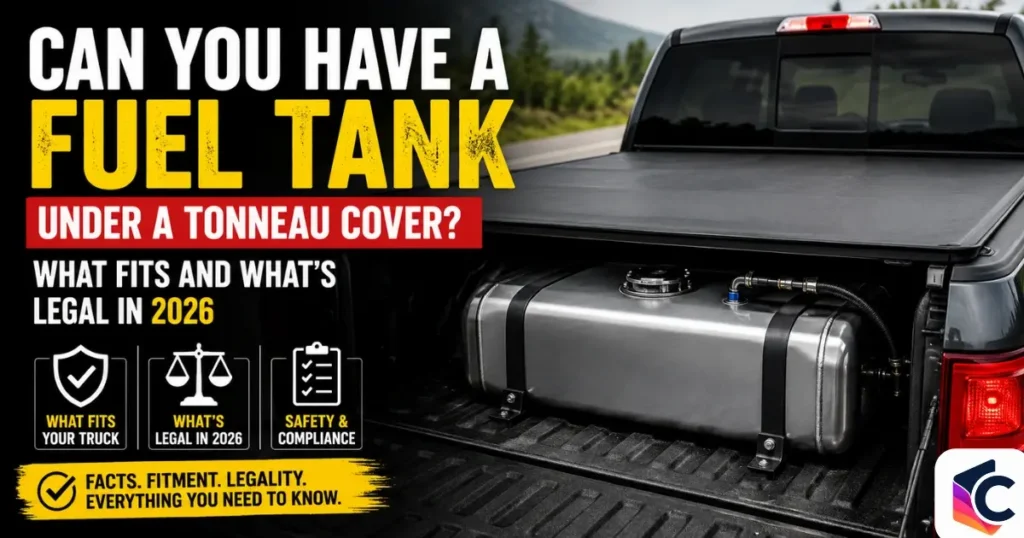
Yes, a fuel tank can sit under a tonneau cover. This refers to a low-profile auxiliary fuel tank built short enough to fit below the closed height of a bed cover, unlike a standard transfer tank that sits above the bed rails.
These tanks are also called under-tonneau tanks, below-bed-rail tanks, or low-profile auxiliary tanks. This article uses “under-tonneau fuel tank” throughout. They’re built for truck owners who want extra range – overlanders, remote workers, and long-haul drivers – without giving up the security and weather protection a tonneau cover provides.
The tank connects directly into your truck’s factory fuel system through a permanent line, not a garden hose or fuel can. That distinction matters both for safety and for which regulations apply.
How Under-Tonneau Fuel Tanks Fit and Function
An under-tonneau tank works by keeping its tallest point below your bed rails, so a closed tonneau cover clears it completely. The tank sits flush within the frame rails and plumbs into the existing fuel line, either through a transfer pump or a direct-fill connection.
Three things determine whether one fits your truck:
Vertical clearance. The distance between your bed floor and the underside of the closed tonneau cover has to exceed the tank’s height. Manufacturers publish this number – one common under-tonneau model needs at least 7 inches of clearance to slide beneath a roll-top cover (ATTA Tank, 2026).
Frame layout. Trucks vary in how much open space exists between the frame rails and the bed. A tank built for an F-150 usually will not bolt into a Silverado without modification (Alibaba Buying Guide, 2026).
Existing bed hardware. A tonneau cover, bed liner, or slide-out tray all take up clearance the tank also needs. Check all three together, not just the cover.
Fuel Type and Legal Capacity: What You’re Allowed to Carry
Federal transportation rules limit how much fuel you can carry before you need hazmat placards and paperwork. For gasoline, that threshold sits around 8 gallons per container without a hazmat placard; auxiliary tanks on pickups generally top out at 119 gallons aggregate before stricter placarding and permitting rules apply (Illinois Administrative Code, 2024).
The Pipeline and Hazardous Materials Safety Administration has confirmed that a properly built auxiliary fuel tank under 119 gallons, wired into the truck’s propulsion system and built to Federal Motor Carrier Safety Regulations standards, does not trigger the full hazardous materials shipping-paper and labeling rules that apply to fuel carried for other purposes (PHMSA, 2007).
That exemption depends on the tank meeting specific construction standards: 18-gauge steel or equivalent aluminum, baffled to stop fuel from surging, electrically bonded to the frame, and permanently connected to the fuel system so it can’t be drained by gravity (Illinois Administrative Code, 2024). A tank that doesn’t meet these standards doesn’t get the same treatment under the law, regardless of size.
State rules can add requirements on top of the federal floor, so check your state’s fire marshal or DOT guidance before installing a large-capacity tank.
Tank Types That Actually Fit Under a Cover
Not every auxiliary tank is built for this. Manufacturers make specific low-profile lines for tonneau compatibility, and the design details separate the ones that fit from the ones that don’t.
| Tank Type | Typical Clearance Needed | Best For |
|---|---|---|
| Below-bed-rail rectangular tank | 7-12 inches | Standard hard or soft tonneau covers |
| Under-toolbox tank | Fits beneath a bed rail toolbox | Trucks that already run a toolbox |
| L-shaped tank | Varies by wheel-well fit | Short beds needing extra capacity around wheel wells |
| Side-holstered pump tank | Up to 17.5 inches | Covers with slightly more clearance |
Some brands, including ATI, sell a tonneau notch modification for transfer tanks that otherwise sit too tall, cutting a channel into the cover to clear the pump housing (Tank Retailer, 2026). Transfer Flow’s under-tonneau line instead mounts the pump in a side holster below the tank’s highest point, so the whole assembly stays under the cover without modifying it (Transfer Flow, 2026).
Common Mistakes to Avoid
- Buying before measuring: A tank’s spec sheet lists required clearance, but your actual clearance depends on your specific tonneau cover model, not just your truck. Measure both before ordering.
- Assuming universal fit: Most kits target specific trucks like the F-150, Silverado 1500, or RAM 1500. A universal-fit claim usually means you’ll be modifying brackets or plumbing yourself (Alibaba Buying Guide, 2026).
- Skipping the capacity math: Adding a 40-gallon auxiliary tank to whatever’s already in your factory tank can push you over the 8-gallon-per-container or 119-gallon aggregate thresholds without you realizing it, triggering placarding requirements you’re not set up for.
- Ignoring state add-on rules: Federal rules set a floor. Some states, like Illinois, add specific construction and labeling requirements on top of it (Illinois Administrative Code, 2024).
- Confusing fuel cans with auxiliary tanks: Portable fuel cans under a tonneau cover fall under different, stricter container limits than a permanently plumbed auxiliary tank.
Frequently Asked Questions About Fuel Tanks Under Tonneau Covers
Can you put a fuel tank under a tonneau cover?
Yes, as long as it’s a low-profile auxiliary tank built to clear the closed height of your specific tonneau cover. Standard transfer tanks sit too tall for most covers.
How much clearance do I need under my tonneau cover for a fuel tank?
Most under-tonneau tanks need between 7 and 17.5 inches of vertical clearance, depending on the model and whether the fuel pump sits on top of or beside the tank (ATTA Tank, 2026; Tank Retailer, 2026).
Is it legal to carry an auxiliary fuel tank in a truck bed?
Yes, up to 119 gallons aggregate for gasoline or diesel on a pickup, provided the tank meets federal construction standards for auxiliary fuel systems and is permanently connected to the vehicle’s fuel system (Illinois Administrative Code, 2024).
What’s the difference between a transfer tank and an under-tonneau tank?
A transfer tank typically sits above the bed rails and needs a separate transfer pump to move fuel. An under-tonneau tank is built shorter specifically to clear a closed bed cover, often with the pump mounted lower or to the side.
Do I need a special permit for a fuel tank under my tonneau cover?
Not for tanks under 119 gallons that meet federal auxiliary fuel tank standards and are used to power the vehicle they’re mounted on. Some manufacturers still supply a DOT special permit with the tank as documentation to carry in the truck (Transfer Flow, 2026).
Will any tonneau cover work with an under-tonneau fuel tank?
No. Roll-top, soft, and hard covers all have different closed-height clearances, and some models need at least 7 inches of clearance underneath to close over the tank (ATTA Tank, 2026).
Key Takeaways
- A fuel tank can go under a tonneau cover only if it’s a low-profile model built for that clearance, not a standard transfer tank.
- Clearance requirements typically run 7-17.5 inches, depending on the tank and pump design.
- Federal rules allow up to 119 gallons of auxiliary fuel capacity on a pickup without triggering hazmat placarding, as long as the tank meets construction and mounting standards.
- Measure your specific truck, bed accessories, and tonneau cover before buying – fitment is model-specific, not universal.

Leave a Reply