
[Published: August 20, 2026 | Last updated: August 20, 2026] | 9 min read
TL;DR
- A tonneau cover can improve highway fuel economy, but results vary widely – from roughly 5% to 12% gains in some tests, and a small loss in others (AmericanTrucks, 2024).
- Gains show up mostly on the highway at sustained speeds above 45 mph. City driving shows little to no change.
- A 1997 Western New England College water tunnel study found tonneau covers cut aerodynamic drag by nearly 12% (Peragon, 2025).
- Hard, low-profile covers perform better than soft or bulky covers because they sit flatter and add less weight.
- At typical fuel prices, payback on a $200-$1,100 cover takes anywhere from roughly 8,800 to 48,000 highway miles, depending on the cover’s cost and your real-world mileage gain (5thGenRams Forum, 2021).
What Is a Tonneau Cover and Why Would It Affect MPG?
A tonneau cover is a panel or fabric top that fits over an open pickup truck bed. It comes in hard, soft, roll-up, and tri-fold styles.
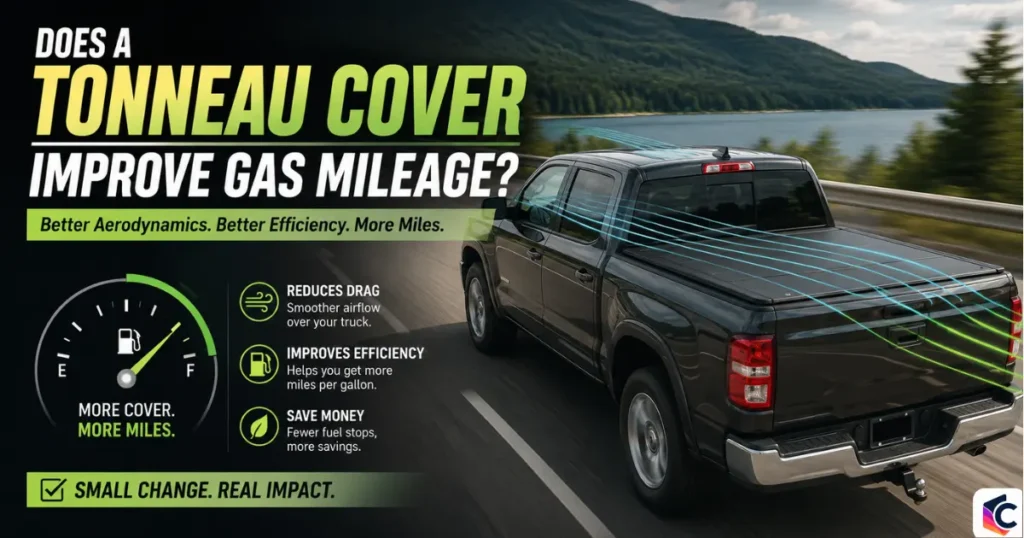
The mileage question comes down to aerodynamics. An open truck bed creates air turbulence as wind drops into the box and swirls around, which adds drag. A cover smooths that airflow over the top of the bed instead of letting it churn inside the box. Less turbulence means the engine works less hard to push the truck through the air, which is where any mileage gain comes from.
What Real-World Tests Found
Independent tests on this question go back decades, and the results are inconsistent. Here’s a summary of the most commonly cited data.
| Test | Result | Source |
|---|---|---|
| Water tunnel study, pickup bed models | Drag reduced by nearly 12% | Western New England College, 1997 (via Peragon, 2025) |
| RAM TRX, before/after on-road test | Highway mpg rose from about 12 to 13.4-14.7 | Forbes, 2024 |
| Highway test, bare bed vs. covered | MPG rose 11.8% on the highway | MOSTPLUS, 2025 |
| Same-truck, same-road test | Mpg dropped slightly, from 22.3 to 21.4 | AmericanTrucks, 2024 |
| Owner-reported average | About 5% real-world gain | 5thGenRams Forum, 2021 |
| Independent on-road tests | Mileage decreased in some cases | Consumer Reports test, cited in MyTeeProducts, 2025 |
The pattern: wind tunnel and water tunnel studies, which isolate drag from every other variable, consistently show a mileage benefit. Real-world road tests are messier, because tire pressure, driving style, wind conditions, and truck model all move the number too.
Why the Results Vary So Much
Three factors explain most of the disagreement between studies.
Speed matters more than distance. Aerodynamic drag increases with the square of speed, so a cover barely registers in city stop-and-go driving but shows up clearly above 55 mph. The Forbes test found no change in city mpg but a jump on the highway (Forbes, 2024).
Cover weight and shape matter. A heavy cover can offset its own aerodynamic benefit. RealTruck’s research found that a lightweight, low-profile cover keeps more of the drag reduction than a bulky one (via Jalopnik, 2025).
Baseline truck aerodynamics matter. A truck that’s already fairly aerodynamic with the tailgate up has less drag to recover than a boxy, high-clearance truck. This is part of why the same test method produces different percentage gains on different trucks.
How Much Gas Money Does This Actually Save?
Take a driver getting 15 mpg who sees a 5% real-world gain, a figure close to several owner-reported results (5thGenRams Forum, 2021). Over 500 highway miles, that driver burns about 1.3 fewer gallons than before. At $3.14 a gallon, that’s roughly $4 saved per 500 miles.
Covers range from about $200 for a basic vinyl roll-up to $1,100 for a solid folding hard cover. At a 5% gain, recouping a $1,100 cover through fuel savings alone takes tens of thousands of highway miles. A commuter who drives mostly city miles, or a truck that only occasionally goes over 55 mph, will see the payback period stretch out even further.
Common Mistakes That Cancel Out the Benefit
- Buying a heavy hard cover for a light-duty truck: The added weight works against the aerodynamic gain. A lighter roll-up or soft cover often yields better mileage results, even though it looks less rugged.
- Leaving the tailgate down with a cover installed: This reopens the airflow path the cover was meant to close and can hurt mileage more than driving with no cover at all.
- Expecting city mileage to improve: Drag reduction barely matters below 45 mph. Judging the cover’s performance based on a week of local errands will yield a misleading result.
- Ignoring tire pressure: Underinflated tires can erase any gain from the cover. The Department of Energy found that keeping tires at the correct pressure can improve fuel efficiency by up to 3% on its own (AmericanTrucks, 2024).
Frequently Asked Questions About Tonneau Covers and Gas Mileage
Does a tonneau cover improve gas mileage?
In most highway-speed tests, yes, typically by somewhere between 5% and 12%. City driving shows little to no change, and at least one controlled test found a small mileage decrease instead (AmericanTrucks, 2024).
How much mpg does a tonneau cover add?
Results range from a slight decrease to about a 12% increase, depending on the truck, the cover, and driving speed. A realistic expectation for highway-heavy driving is a 5% to 10% gain.
Do hard tonneau covers save more gas than soft ones?
A hard cover creates a flatter, more consistent surface, which can reduce drag more effectively than a soft or roll-up cover. But a heavy hard cover can also add weight that offsets part of that gain, so a lightweight design matters more than material alone.
Is the fuel savings from a tonneau cover worth the cost?
For a driver who covers mostly highway miles at 55+ mph, a mid-priced cover can pay for itself in fuel savings over tens of thousands of miles, on top of the cargo protection and security it adds. For a mostly-city driver, the mileage benefit alone won’t cover the cost.
At what speed does a tonneau cover start improving mileage?
Aerodynamic drag reduction becomes noticeable above roughly 45-50 mph, since drag increases with the square of speed. Below that, other factors like acceleration and idling dominate fuel use.
Key Takeaways
- Highway-speed driving is where a tonneau cover can actually move the mpg needle. City driving won’t show much change.
- Lightweight, low-profile covers tend to preserve more of the aerodynamic benefit than heavy hard covers.
- Real-world gains reported in tests and by owners range from a small loss to about 12%, with 5-10% being a reasonable expectation for consistent highway driving.
- Fuel savings alone rarely justify a premium cover’s price tag on a fast timeline. Cargo protection and security are usually the bigger reason to buy one.

Leave a Reply