
[Published: July 13, 2026 | Last updated: July 13, 2026]
TL;DR
- Measure seat width, back height, and seat depth with a tape measure before you shop, then match those numbers to the product listing.
- Check whether your seats are bucket or bench style first. This one detail changes which cover category you need.
- If your car has side-mounted airbags, only buy covers labeled as airbag-compatible with a tear seam over the bag zone.
- Universal-fit covers rely on stretch fabric and fit a wide range of seats loosely. Custom or semi-custom covers are cut to your exact make, model, and year.
- Compare your measurements against the manufacturer’s fit chart, not just the size label on the package.
What You Need Before You Start
- A soft fabric tape measure (a rigid ruler will not follow the seat’s curves accurately)
- A pen and paper, or your phone’s notes app, to log each measurement
- Your car’s make, model, year, and trim level
- Your owner’s manual, if you have it, to check for factory seat specs and airbag locations
Step 1: Identify Your Seat Type
Look at your front and rear seats before you measure anything. Front seats are almost always bucket seats, individual seats with their own backrest and cushion. Rear seats can be bucket, bench, or a 60/40 split bench that folds down separately. <cite index=”8-1″>Bucket seat covers are cut to fit a single seat snugly, while bench seat covers are designed to cover a wider area without gaps</cite>.
Also note any extras that affect fit: fixed or adjustable headrests, fold-down armrests, seat-mounted controls, and heating or cooling elements. <cite index=”8-1″>If your seats are heated or ventilated, the cover material needs to allow airflow, since thicker or non-breathable fabric can reduce heat transfer over time</cite>.
Step 2: Check for Side Airbags Before You Measure
This step comes before measuring because it can rule out entire categories of covers. Many modern seats house a side-impact airbag inside the outer seatback bolster. <cite index=”15-1″>Side-impact airbags inflate faster than frontal airbags because there is less space between the occupant and the point of impact</cite>.
Federal rules do not currently require a specific fit standard for aftermarket seat covers. <cite index=”17-1″>NHTSA has confirmed there is no Federal Motor Vehicle Safety Standard that directly applies to aftermarket slip-on seat covers</cite>, even though the seats themselves must meet FMVSS No. 214 for side-impact protection (NHTSA, 2007). That gap in oversight means fit accuracy over airbag zones is on you as the buyer, not guaranteed by regulation.
Look for a small tag or icon on the outer seatback seam that marks an airbag location. If you find one, buy only covers built with a matching tear seam or breakaway panel over that zone, and confirm the panel lines up once installed. A 2023 recall of upper seat covers showed what happens when that seam is off: incorrect stitching prevented the side airbag from deploying as designed (NHTSA, 2023).
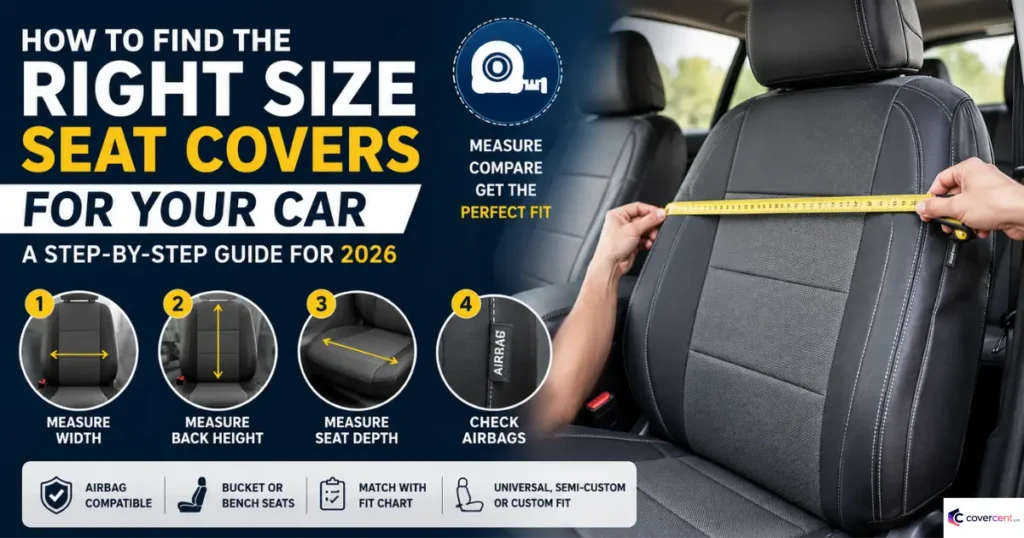
Step 3: Measure Seat Width (Shoulder Room)
Sit the seat in its normal driving position, not reclined or slid back. Measure the seat back horizontally at its widest point, roughly where your shoulders rest. <cite index=”9-1″>This measurement reflects how much room your shoulders have when you are seated</cite>. Record it in inches.
Seat width varies more between vehicles than most buyers expect. <cite index=”7-1″>A compact sedan’s front seat can measure around 50 inches across the shoulder area, while a full-size pickup’s seat runs noticeably wider</cite>. A cover sized for the wrong category will bunch or sag no matter how good the fabric is.
Step 4: Measure Back Height and Seat Depth
Measure the backrest from where it meets the cushion up to the top edge, below the headrest unless your cover is designed to wrap over it. Then measure the seat base from the front edge to where it meets the backrest. This is your seat depth, sometimes called seat length.
<cite index=”10-1″>Take both width and height measurements at the widest points on the base, then repeat the same process on the backrest</cite>. Small inconsistencies here are normal. What matters is capturing the largest dimension so the cover has enough material to wrap the full seat without gaps at the seams.
Step 5: Measure Hip Room and Note Special Features
Measure the seat bottom at its widest point, where your hips rest when seated. <cite index=”8-1″>This dimension helps you choose a cover that covers the seat completely, without leaving exposed areas prone to wear</cite>.
While you have the tape measure out, log every feature that could interfere with a cover: armrests, integrated seat belts, lumbar adjustment levers, memory-seat buttons, and any storage pockets built into the seatback. <cite index=”13-1″>Compare these measurements and features against the specifications listed for the covers you’re considering, so nothing gets blocked once the cover is installed</cite>.
Step 6: Compare Your Numbers to the Product’s Fit Chart
Once you have all four measurements, check them against the actual fit chart on the product page, not just the general size label like “small SUV” or “standard sedan.” <cite index=”7-1″>The closer your measurements match the cover’s listed dimensions, the better the fit. A wide gap between the two numbers means loose fabric and constant readjustment</cite>.
Many retailers also let you search by make, model, and year to pull up a pattern built for your exact seat, which skips manual measuring for custom-fit products. <cite index=”8-1″>Your vehicle’s owner’s manual is another reliable source for seat width, back height, and unique seat contours</cite>, and it’s worth cross-checking against your own tape-measure results before you order.
Step 7: Choose Universal, Semi-Custom, or Custom Fit
The three main categories trade off cost against precision.
| Fit Type | How It’s Made | Best For |
|---|---|---|
| Universal | One stretch-fabric pattern sized to fit a broad range of seats | Budget buyers, temporary protection, simple bucket seats |
| Semi-custom | Stretch fabric cut closer to common seat shapes, with some adjustable panels | Buyers who want a snugger look without full customization |
| Custom-fit | Built from the exact factory pattern for your make, model, year, and trim | Seats with side airbags, unusual bolsters, or built-in controls |
<cite index=”13-1″>Universal-fit covers are typically easier to find and quicker to install, while custom-fitted versions provide a closer match to the original upholstery with less bunching or slipping</cite>. If your seats have side airbags, integrated controls, or a non-standard bolster shape, the tighter tolerance of a custom or semi-custom cover is worth the extra cost.
Step 8: Install and Recheck the Fit
Position the cover at the top of the seat first, then work the fabric down over the backrest and base, keeping any front-facing tags or labels correctly oriented. Align the seams with the seat’s natural lines, especially where the backrest meets the cushion and around any built-in armrests or headrests.
Secure any straps or hooks starting from the center of the seat and working outward, then sit in the seat the way you actually drive. Check that airbag panels sit loose enough to release, that seat controls remain reachable, and that no strap crosses a labeled airbag zone. If anything feels tight or misaligned, loosen the straps and re-seat the cover before driving.
Common Problems and How to Fix Them
| Problem | Likely Cause | Solution |
|---|---|---|
| Cover bunches at the seat back | Cover is a universal size too large for a bucket seat | Switch to a semi-custom or custom-fit cover matched to your seat width |
| Cover won’t sit flush over side bolster | Airbag panel or tear seam is misaligned | Reposition the cover so the panel matches the factory airbag label, or return it for the correct model |
| Seat controls or armrests are blocked | Measurements didn’t account for special features | Recheck Step 5 and buy a cover with cutouts for those specific features |
| Cover slides or rides up while driving | Straps not secured evenly, or fabric has too much stretch | Re-tighten straps evenly from center to edges, or size down to a snugger fit |
| Headrest doesn’t fit through the cover | Cover doesn’t account for fixed vs. removable headrests | Confirm headrest type before ordering; some covers wrap over, others fit around |
Frequently Asked Questions
How do I know what size seat covers fit my car?
Measure seat width, back height, and seat depth with a tape measure while the seat is in its normal driving position, then compare those numbers to the fit chart on the product listing rather than relying on a generic size label.
Are universal seat covers as good as custom-fit ones?
Universal covers cost less and install faster, but they rely on stretch fabric to approximate a fit across many seat shapes. Custom-fit covers are cut from your vehicle’s exact seat pattern, which matters most if your seats have side airbags or built-in controls.
Can seat covers interfere with my airbags?
Yes, if the cover’s stitching or panel doesn’t line up with the seat’s airbag zone. Confirm the cover is labeled airbag-compatible and check the seam alignment after installation, since federal rules don’t currently set a fit standard for aftermarket covers (NHTSA, 2025).
Do I need different measurements for bench seats versus bucket seats?
Yes. Bucket seats are measured individually, while bench seats need a single set of measurements across the full width, plus notes on any split sections, fold-down armrests, or cupholders built into the bench.
What if my seats have heating or cooling built in?
Choose a cover made from breathable material, since thick or non-breathable fabric can reduce how well heated or ventilated seats transfer temperature through the cover.
Summary
- Identify your seat type and check for side airbags before you measure anything.
- Measure seat width, back height, seat depth, and hip room, and log any special features.
- Match your numbers to the product’s actual fit chart, not a generic size label.
- Pick universal, semi-custom, or custom fit based on how much precision your seats need.
- Install carefully and recheck airbag zones and seat controls before driving.
References
- National Highway Traffic Safety Administration, “Vehicle Air Bags and Injury Prevention,” NHTSA.gov
- National Highway Traffic Safety Administration, Interpretation Letter 08-002983, “Slip-On Seat Cover,” NHTSA.gov
- National Highway Traffic Safety Administration, Part 573 Safety Recall Report 23E-058, static.nhtsa.gov

Leave a Reply