
[Published: 11 October 2026 | Last updated: 11 October 2026] | 7 min read
TL;DR
- Yes, you can move a drain cover (manhole cover) to build an extension, but you cannot simply shift the lid. The manhole is removed, and a new one is built outside the extension footprint.
- If the drain is a public sewer, you need a Build Over Agreement from your water company before work starts. Building over or within 3m of a public sewer triggers this rule (Homebuilding, 2021).
- The application fee is typically around £300, and most applications are processed within three weeks (Homebuilding, 2021).
- You must use a Full Plans Building Regulations application. You cannot use the Building Notice route when building over or close to a public sewer (Homebuilding, 2021).
- Redesigning the extension to stay 3m clear of the sewer is usually the cheapest alternative.
Can You Move a Drain Cover to Build an Extension?
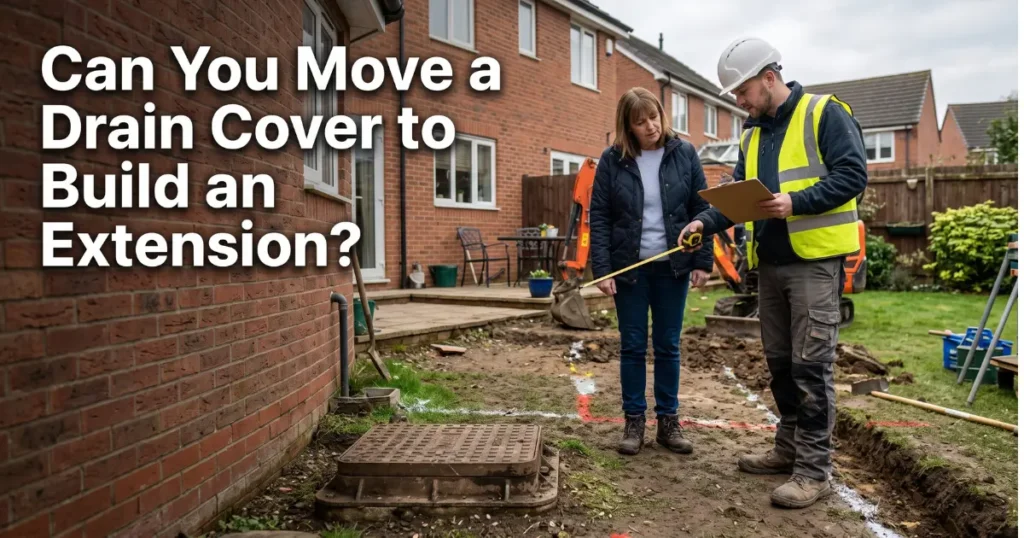
Yes, in most cases. The drain cover is the lid of an inspection chamber (also called a manhole), and you can remove and rebuild the chamber in a new position. The pipe underneath must stay accessible, so the new chamber goes outside the extension, usually in the garden.
You are not allowed to keep a manhole inside the new floor area. Water companies and Building Control reject internal manholes, even double-sealed ones, because of the risk of internal flooding and odours (Homebuilding, 2021).
Two things decide how complicated the job is: who owns the drain, and how close your foundations come to it.
Who Owns the Drain: Private Drain or Public Sewer?
A private drain serves only your property and you maintain it. A public sewer is owned by the water company and usually serves several properties.
Ownership changes the paperwork completely:
- Private drain: You can build over it, and Building Control will want to inspect and approve the work as part of the extension (Ideal Home).
- Public sewer: You need a Build Over Agreement before work begins.
There is one catch for private drains. If you build within 1m of the point where the drain leaves your boundary, some water companies still require an agreement (Homebuilding, 2021). Check with your water company before you finalise the design.
Not sure which type you have? Ask your water company for its sewer records, or commission a drainage survey.
What Is a Build Over Agreement and When Do You Need One?
A Build Over Agreement (BOA) is a legal agreement between you and your water company. It confirms that your extension will not damage a public sewer and that the company keeps access for repairs (Homebuilding, 2021).
You need one for any construction over a public sewer or within 3m of it (Homebuilding, 2021). Some modern properties also carry this obligation as a covenant in the deeds.
Skipping the agreement is risky. If the water company finds out, it can force you to stop work or even take down what you built over the sewer. Building Control will also refuse the Completion Certificate, which you need to sell or remortgage (Homebuilding, 2021).
How Do You Move a Manhole for an Extension? Step by Step
Moving a manhole takes seven steps, and the application stage controls the timeline.
- Confirm ownership. Contact your water company and ask whether the pipe is a private drain or a public sewer.
- Get a drainage survey. A survey shows the pipe route, depth and condition, so the design is checked before you commit (Homebuilding, 2021).
- Design the new layout. Your designer places a new chamber outside the extension, either on the sewer line or offset and linked by a Y junction (Homebuilding, 2021).
- Apply for the Build Over Agreement. Submit the form, the fee and drawings (listed in the next section).
- Submit a Full Plans application to Building Control. Do not use a Building Notice.
- Build the new chamber and remove the old one. Do this before or alongside the foundations, following the agreed design.
- Book inspections. Building Control makes periodic site visits and typically wants to see the drain test before backfilling (Trade2Base, 2026).
What Drawings Does a Build Over Agreement Application Need?
The application needs four documents. Water companies may ask for slightly different versions, so check their requirements first (Homebuilding, 2021).
- A plan of the existing house and drainage, with the sewer’s flow direction marked.
- A plan of the proposed extension and drainage, showing the old manhole removed and the new chamber in the garden.
- A site location plan.
- A cross section showing foundations against the sewer. This is only required if you build directly over the sewer or within 1.5m of it.
You can usually adapt the drawings used for your planning application.
What Are the Technical Rules for Building Over a Sewer?
Building Regulations Approved Document H (Part H) governs drainage, and section H4 covers building over sewers (Trade2Base, 2026). The common technical requirements are below (Homebuilding, 2021).
| Requirement | Typical Rule |
|---|---|
| Foundation clearance from the pipe | 600mm, or sometimes less where the sewer is shallower than 1.1m |
| Clearance where the sewer is deeper than 2m | A clear 1m to the new foundations |
| Foundation depth | Deeper than the pipe’s invert level (the bottom of the pipe) |
| Distance from chamber walls | At least 600mm |
| Replacement pipe material | Like for like, so clay replaces clay |
| Pipe bedding | Pea shingle, never encased in concrete |
| Internal manholes | Not allowed |
The aim is for your foundations to bridge over the sewer rather than load it. Concrete lintels are a common way to do this.
How Much Does It Cost and How Long Does It Take?
The Build Over Agreement fee is typically around £300, and applications are normally processed within three weeks (Homebuilding, 2021). Check your water company’s website for its current fee, because pricing varies by company.
The building work itself is usually straightforward unless you must divert the sewer or construct new manholes. Those jobs add cost, and a drainage contractor’s quote is the only reliable figure.
Delays happen. One South Wales couple reported that their application to move a main sewer manhole took nearly six months to approve (Homebuilding, 2021). Submit complete drawings the first time, since missing information is the usual cause of delay.
What Are the Alternatives to Moving the Manhole?
You have two alternatives, and both are covered in Homebuilding (2021).
- Redesign the extension. Keep the new building at least 3m from the sewer. This is usually the simplest and cheapest option, though design changes may need to be notified to the local planning authority.
- Divert the sewer. This needs professional design and prior consent from the water company. It is often expensive and disruptive, although your own contractor may be allowed to do the work, which helps control cost.
Do You Need Your Neighbour’s Permission to Move a Shared Manhole?
It depends on where the manhole sits and who the drain serves. A manhole on the boundary, or one serving several houses, affects other owners, and the water company may need to approve any change.
Homeowners on forums report neighbours refusing consent to alter a shared manhole, which can stall a project. Raise the plan with neighbours early, and ask your water company and Building Control what approvals your layout needs. A party wall surveyor can advise if the extension also affects a shared boundary.
Frequently Asked Questions About Moving a Drain Cover for an Extension
Can I build an extension over a manhole cover?
You cannot leave a manhole cover inside the extension. The manhole must be removed and replaced with a new chamber outside the building, linked to the pipe by a Y junction or placed on the sewer line (Homebuilding, 2021).
Do I need permission to move a drain cover?
If the drain is a public sewer, you need a Build Over Agreement from your water company. For a private drain, you need Building Control approval, and some water companies also want notice if you build within 1m of the boundary (Homebuilding, 2021).
How close can I build to a public sewer?
You need an agreement for any work over a sewer or within 3m of it. Foundations typically need 600mm clearance from the pipe, or 1m where the sewer is deeper than 2m (Homebuilding, 2021).
Can I use a Building Notice for work over a sewer?
No. You must submit a Full Plans application when building over or close to a public sewer (Homebuilding, 2021).
How long does a Build Over Agreement take?
Most applications are processed within three weeks, and you can start work as soon as the agreement is issued. Incomplete drawings are the most common cause of delay (Homebuilding, 2021).
What happens if I build over a sewer without an agreement?
The water company can order work to stop or require demolition of the part built over the sewer. Building Control will also withhold the Completion Certificate, which blocks a future sale or remortgage (Homebuilding, 2021).
Is moving a drain cheaper than redesigning the extension?
Usually not. Keeping the extension 3m clear of the sewer is typically the simplest and cheapest route, provided your design only intrudes slightly into that zone (Homebuilding, 2021).
Key Takeaways
- A manhole can be moved, but only by removing it and building a new chamber outside the extension.
- Find out whether the drain is private or a public sewer before you finalise the design.
- Apply for the Build Over Agreement early, and use a Full Plans Building Regulations application.
- Budget around £300 for the agreement fee, plus the cost of drainage work and a survey.
References
- Homebuilding & Renovating (Ian Rock, 2021): “What is a Build Over Agreement?” – https://www.homebuilding.co.uk/advice/what-is-a-build-over-agreement
- Ideal Home: “Can you move drains as part of an extension?” – https://www.idealhome.co.uk/renovation/extensions/can-you-move-drains-as-part-of-an-extension
- Trade2Base (2026): “Building Regs Part H (Drainage): A Trade’s Guide” – https://www.trade2base.com/blog/trade-business-part-h-drainage-uk

Leave a Reply