
[Published: July 22, 2026| Last updated: July 22, 2026] | 8 min read
TL;DR
- You can sleep under a tonneau cover, but only certain cover types are safe and practical for overnight use.
- Hard-folding and retractable covers offer enough structure and ventilation options to sleep under safely.
- Soft roll-up covers are not safe for sleeping – they offer no structural support and trap CO2.
- Truck bed sleeping is legal in most U.S. states while parked on private property or designated campgrounds, but laws vary by location.
- A truck bed with the right cover, pad, and ventilation setup can work as a low-cost alternative to tent camping or van life.
Is It Safe to Sleep Under a Tonneau Cover?
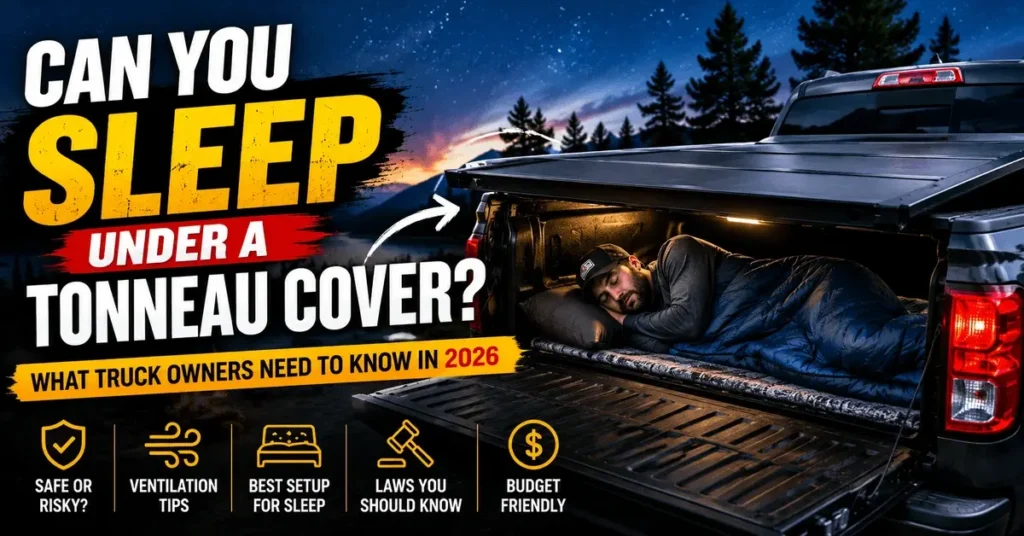
Sleeping under a tonneau cover is safe under specific conditions – the right cover type, proper ventilation, and a stationary truck. The biggest risks are CO2 buildup from poor airflow, structural collapse from a weak cover, and legal issues in certain jurisdictions. Get those three things right, and a truck bed is a functional sleeping space.
The cover type is the deciding factor. Hard covers (hard folding, retractable, one-piece fiberglass) hold their shape and can be propped open for airflow. Soft covers (roll-up, snap, tri-fold soft) have no rigid structure and can sag onto a sleeping person – they are not safe for overnight use.
Which Tonneau Cover Types Work for Sleeping
Not every tonneau cover is built for sleeping. Here is how the main types compare:
| Cover Type | Safe to Sleep Under? | Why |
|---|---|---|
| Hard folding (aluminum panels) | Yes | Rigid panels can be partially opened for ventilation |
| Retractable (aluminum slats) | Yes | Strong structure, opens to any position |
| One-piece fiberglass | Yes, with caveats | Solid structure but no ventilation unless propped |
| Soft tri-fold | No | Flexible panels sag under pressure |
| Soft roll-up | No | No structure, collapses, traps air |
| Snap-on soft | No | Same problem as roll-up |
If you already own a hard folding cover like the BAKFlip MX4 or the Extang Trifecta ALX, you have a cover that can handle an adult’s weight and stay open a few inches for airflow. If you own a soft cover, sleeping under it is not worth the risk.
The Ventilation Problem: Why Airflow Matters More Than Comfort
Ventilation is the most overlooked factor when sleeping in an enclosed truck bed. A sealed truck bed accumulates CO2 from your breath within a few hours. In a fully enclosed space, CO2 levels can reach uncomfortable or dangerous concentrations overnight.
The fix is simple: leave your cover cracked open 2-4 inches on one side. Most hard folding and retractable covers can stay in a partially open position without a prop. For one-piece covers, use a short piece of wood or a dedicated prop rod to hold one end up.
Additional ventilation tips:
- Park with the tailgate end facing the prevailing wind so air moves through the bed.
- Leave a 2-4 inch gap at the rear of the cover even in cold weather – a sleeping bag handles temperature better than CO2 buildup.
- Do not run any engine, generator, or propane heater inside or near the bed with the cover closed. Carbon monoxide is lethal in enclosed spaces.
How to Set Up a Truck Bed for Sleeping
A workable truck bed sleep setup does not require expensive gear. These are the core components:
Step 1: Measure your bed
Standard truck bed lengths run 5.5 ft, 6.5 ft, and 8 ft. Most adults need at least 6 ft of flat space to sleep straight. If your bed is 5.5 ft, you will need to sleep diagonally or use a truck bed extender that bridges the cab and bed.
Step 2: Level the surface
Wheel wells create a broken, uneven floor. Options to bridge them: a purpose-built truck bed sleeping platform (brands like GoShurack or DIY plywood builds), an inflatable mattress sized for the bed width, or a foam sleeping pad cut to fit.
Step 3: Choose a mattress
- Inflatable truck bed air mattresses (search “truck bed air mattress 6.5 ft”) fill around wheel wells and pack down small.
- Foam sleeping pads (2-3 inch closed-cell or memory foam) are lighter and do not puncture.
- A standard twin mattress fits a 6.5 ft bed but adds weight and cannot be quickly removed.
Step 4: Set up ventilation before you sleep
Crack the cover 2-4 inches. If temperatures require it, add a small battery-powered fan pointed toward the gap to pull fresh air through.
Step 5: Handle privacy and light
Hard covers block light entirely once closed. If you need a blacked-out sleeping space, a hard cover is better than a tent. For additional privacy at the tailgate, a tailgate gap cover or a simple tarp draped over the opening works well.
Is It Legal to Sleep in a Truck Bed?
Sleeping in your truck bed is legal in most U.S. states while parked on private property, in campgrounds, or in designated overnight parking areas. The situation gets complicated in three areas:
Moving vehicles: In most states, it is illegal for a passenger to ride or sleep in a truck bed while the vehicle is in motion. This applies even with a tonneau cover closed.
Public property and urban areas: Many cities prohibit sleeping in vehicles on public streets. Enforcement varies widely, but places like Los Angeles, San Francisco, and Seattle have ordinances that may apply to truck bed sleeping. Always check local rules before parking overnight on a public street.
Rest stops: Most state highway rest stops allow overnight parking for 8-10 hours. Sleeping in your truck bed at a rest stop is generally tolerated but not officially approved in every state.
The safest legal options for overnight truck bed camping: private campgrounds, national forest dispersed camping areas (free and legal for up to 14 days in most forests), BLM (Bureau of Land Management) land, and private driveways with permission.
Truck Bed Sleeping vs. Other Budget Camping Options
Sleeping in your truck bed is not for everyone, but it fills a specific gap between tent camping and van life.
| Option | Cost | Setup Time | Privacy | Weather Protection |
|---|---|---|---|---|
| Truck bed (hard cover) | $0 extra if you own the cover | 5-10 minutes | High | Good (not waterproof in heavy rain) |
| Ground tent | $50-$300 for tent | 15-30 minutes | Low | Good |
| Rooftop tent | $800-$4,000 | 5 minutes | Medium | Excellent |
| Van conversion | $5,000-$30,000+ | 0 (always ready) | High | Excellent |
The truck bed wins on cost and setup speed. The trade-offs are a shorter sleeping surface compared to a van, more noise sensitivity, and the need to clear out gear every time you need truck bed access.
Common Mistakes People Make When Sleeping Under a Tonneau Cover
- Closing the cover completely: Even in cold weather, a fully sealed truck bed will accumulate CO2. Always leave a gap.
- Using a soft cover: Soft covers are not structural. They sag, restrict airflow, and can press down on a sleeping person.
- Skipping the sleeping pad: The truck bed floor is metal and transfers cold quickly. Even in mild weather, sleeping directly on bare metal leads to a poor night of sleep.
- Parking on a slope without adjusting: Sleeping on a sideways or front-to-back slope adds up over 6-8 hours. Park as level as possible or use leveling blocks under the tires.
- Not checking the weather: Hard covers shed water but are not fully waterproof in heavy rain. A downpour can find gaps around seals and leak into the bed.
Frequently Asked Questions About Sleeping Under a Tonneau Cover
Can you sleep in a truck bed with a tonneau cover in winter?
Yes, but cold management is the main challenge. A closed hard cover holds body heat better than a tent because it creates a small enclosed space. Use a sleeping bag rated for temperatures 10-15 degrees below the expected overnight low, add a foam sleeping pad to insulate from the metal floor, and crack the cover slightly for airflow even in cold temperatures.
Will a tonneau cover keep rain out while sleeping?
Most hard tonneau covers shed light to moderate rain well. In heavy rain, water can seep through the tailgate gap or along the side seals. Sealing the tailgate gap with a foam strip and checking your cover seals before an overnight trip reduces leakage. A waterproof sleeping bag cover or tarp over your pad is cheap added insurance.
How much weight can a tonneau cover hold?
Hard folding aluminum covers typically hold 200-400 lbs of evenly distributed weight, depending on the brand and model. Retractable aluminum slat covers are rated similarly. One-piece fiberglass covers vary by manufacturer. Always check your specific cover’s rated load capacity before sleeping under it. Soft covers have no meaningful load rating and should not be slept under.
Do I need to remove my tonneau cover to sleep in the truck bed?
No. The point of sleeping under the cover is that it acts as your roof. You sleep inside the bed with the cover closed or partially open above you. You only remove the cover if you prefer to sleep under the open sky, which is a separate choice.
Is sleeping in a truck bed comfortable enough for multiple nights?
It depends on your setup. With a quality inflatable mattress or foam pad and a sleeping bag suited to the weather, most people find it comfortable for 2-5 night trips. For longer trips, the limited space (especially in 5.5 ft beds) and the inability to sit upright become the main discomforts. A sleeping platform that raises the bed floor to clear the wheel wells improves comfort significantly for extended use.
Key Takeaways
- Hard tonneau covers (hard folding, retractable, one-piece fiberglass) are safe to sleep under. Soft covers are not.
- Always crack the cover 2-4 inches for ventilation. Never sleep in a fully sealed truck bed.
- A foam or inflatable sleeping pad is required – sleeping on bare metal is cold and uncomfortable regardless of air temperature.
- Truck bed sleeping is legal in most dispersed camping and campground settings. Check local ordinances before sleeping on public streets.
- For trips under a week, a truck bed with a hard cover is a fast, low-cost, and practical camping setup.
References
- BAK Industries – BAKFlip tonneau cover load ratings and product specs: https://www.bakflip.com
- U.S. Bureau of Land Management – dispersed camping rules and overnight parking guidelines: https://www.blm.gov/programs/recreation/camping
- REI Expert Advice – truck camping gear and sleeping pad selection: https://www.rei.com/learn/expert-advice/sleeping-pads.html

Leave a Reply