
Published: [July 22, 2026] | Last updated: [July 22, 2026] | 7 min read
TL;DR
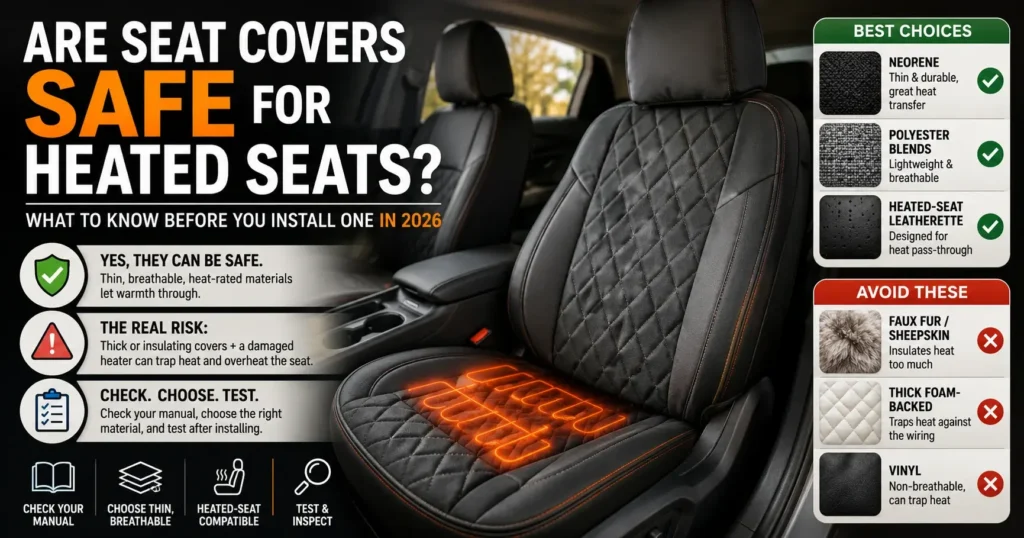
- Yes, seat covers are safe for heated seats if the material is thin, breathable, and rated for heat transfer – thick or foam-backed covers are the real risk.
- The danger isn’t the cover catching fire on its own. It’s a cover trapping heat against a damaged or aging heating element, which can overheat the seat.
- NHTSA reviewed 138 complaints about malfunctioning seat heaters over a six-year span, and 69 of those mentioned fire or visible flames (Edmunds, 2015).
- Neoprene, polyester blends, and covers labeled “heated-seat compatible” are the safest picks. Avoid faux fur, vinyl, and quilted foam covers.
- Always check your owner’s manual first – some automakers void heating-element warranties if a non-approved cover is installed.
Are Seat Covers Safe for Heated Seats?
Seat covers are safe for heated seats as long as the fabric lets heat pass through instead of trapping it. A thin, breathable cover barely changes how the seat warms up. A thick, insulated, or foam-backed cover can hold heat against the seat’s wiring, which raises the risk of overheating over time.
The real safety question isn’t “cover or no cover.” It’s “which material.” Heated seats warm the cushion using a resistive wire or heating mat built into the foam, similar to the coil in an electric blanket. The mechanism is typically made up of three parts: a resistor (the heating coil), a relay, and a thermostat (CarParts.com, 2024). That thermostat is what keeps a properly functioning seat from overheating, whether or not a cover is on top of it.
Problems tend to show up in two scenarios: a cover thick enough to block the thermostat from sensing heat correctly, or a seat heater that’s already damaged and starts drawing more current than it should. A cover doesn’t create the second problem, but it can make it worse by holding heat in one spot instead of letting it dissipate.
How Heated Seats Actually Work
A heated seat warms you through a resistive element embedded in the cushion foam, not an open flame or exposed coil. Electricity flows through a strip of wire (the resistor), and a thermostat cycles the heat on and off to hold a set temperature.
Automakers apply heat to seats in a few different ways, ranging from thin “strip weave” wires embedded in the foam to heat-conducting cables that warm broader areas of the seat cushion (Jalopnik, 2025). Regardless of the method, the wiring sits just under the seat’s fabric or leather surface, which is exactly where a seat cover lands too.
This layout matters for one reason: anything that sits between the heating element and your body changes how fast heat reaches you and how easily excess heat escapes. A thin cover barely registers. A thick one acts like a blanket over the wiring.
When a Seat Cover Becomes a Fire Risk
A seat cover becomes a fire risk mainly when it’s made from thick, non-breathable, or meltable material and it’s paired with a heating element that’s already worn or damaged. On its own, a quality cover doesn’t ignite from normal seat-heater temperatures.
The bigger concern is what happens when a heater fault meets an insulating cover. If a cover is too thick or traps heat instead of dispersing it, the trapped heat puts stress on both the heating element and the occupant sitting on it (FREESOO, 2024). Trapped heat also stresses the wiring itself, and stressed wiring is more likely to fray or short over time.
Real-world complaint data backs up why this matters. Over a six-year period, NHTSA logged 138 complaints tied to malfunctioning seat heaters, and 69 of those complaints described smoke or actual flames (Edmunds, 2015). Mercedes and BMW accounted for the largest share of those reports, with 34 and 27 complaints respectively (Edmunds, 2015). Several automakers have also issued heated-seat recalls over the years, including Jeep’s 2006 recall of more than 111,000 Grand Cherokee models after seat-heater fires and overheating reports (CarBuzz, 2024).
None of this means heated seats are unsafe to use. It means a worn heating element plus an insulating cover is a worse combination than either problem alone.
Which Seat Cover Materials Are Safe for Heated Seats
The safest seat covers for heated seats are thin, breathable, and specifically listed as compatible with seat heaters. Material choice matters more than brand or price when it comes to heat transfer.
| Material | Safe for Heated Seats? | Why |
|---|---|---|
| Neoprene (thin, seat-specific) | Yes | Conducts heat well, holds shape, used in many factory-style covers |
| Polyester/cotton blends | Yes | Lightweight and breathable, minimal heat blocking |
| Leatherette designed for heated seats | Usually yes | Manufacturers test these for heat pass-through |
| Thick foam-backed covers | No | Traps heat against the wiring |
| Faux fur or sheepskin | No | Insulates heavily, slows or blocks heat transfer |
| Vinyl (non-vented) | Caution | Can trap heat and isn’t always breathable |
Thin, breathable materials like polyester and certain durable blends typically allow efficient heat transfer, while thick, foam-backed, or heavily insulated materials can block heat and potentially damage the heating elements (TigerTough, 2024). If a product listing doesn’t mention heated-seat compatibility at all, treat that as a sign to keep looking rather than assume it’s fine.
How to Check If Your Seat Covers Are Compatible
Confirm compatibility before you install anything by checking three things: your owner’s manual, the cover’s product listing, and the fit around your specific seat controls. Skipping this step is the most common reason people end up with a cover that fights their heater.
Start with the manual. Some automakers warn against replacing seat covers on a heated seat at all, and some caution against blankets, cushions, or anything else that could insulate the heat (CarParts.com, 2024). That warning exists because certain factory heating systems are more sensitive to insulation than others.
Next, check the listing for explicit heated-seat or seat-heater compatibility language, not just “universal fit.” A cover cut for your exact make and model will also sit flatter, which matters because a loose or bunched cover can create hot spots by pressing unevenly on the heating mat.
Finally, test after installing. Turn the heater on, run it for a few minutes, and check for uneven warmth, odd smells, or slower-than-normal heating. Any of those is a reason to remove the cover and reassess, not to keep driving and see what happens.
Common Mistakes to Avoid
- Buying the cheapest available cover: Low-cost covers are more likely to use foam backing or non-breathable synthetic layers that insulate rather than transmit heat.
- Ignoring the owner’s manual: A handful of manufacturers explicitly restrict seat covers on heated seats, and installing one anyway can affect your warranty coverage.
- Choosing thick or fur-lined covers for winter comfort: The materials that feel warmest to sit on unheated are usually the worst at letting heater warmth through.
- Skipping the fit check: A cover that bunches or shifts creates uneven pressure points, which can concentrate heat in one spot instead of spreading it evenly.
- Never inspect the seat underneath: Covers hide wear. Check periodically for melted spots, discoloration, or a burning smell, since a cover can mask early warning signs of a failing heater.
Frequently Asked Questions About Seat Covers and Heated Seats
Are seat covers safe for heated seats?
Yes, as long as the material is thin, breathable, and rated for heat transfer. Thick, foam-backed, or insulating covers are the ones that raise risk, not seat covers in general.
Can a seat cover cause a heated seat to catch fire?
A quality, breathable cover doesn’t ignite from normal seat-heater temperatures on its own. The risk goes up when an insulating cover is combined with a heating element that’s already damaged or worn.
What material is best for seat covers on heated seats?
Thin neoprene, polyester blends, and leatherette products labeled as heated-seat compatible perform best. They let warmth pass through instead of holding it against the seat’s wiring.
Will a seat cover reduce the effectiveness of my heated seats?
It can slightly slow how quickly the seat warms up or make it feel a bit less hot, but a properly chosen thin cover shouldn’t meaningfully affect the heating performance.
Do I need special seat covers if I have leather heated seats?
You need seat covers that are breathable and heat-conductive regardless of whether your factory seats are leather or fabric. The material of the cover matters far more than the material underneath it.
How do I know if my current seat covers are damaging my heater?
Watch for slower heating, uneven warmth across the seat, a burning smell, or visible discoloration on the cover. Any of these signs means the cover should come off so you can inspect the seat underneath.
Key Takeaways
- Seat covers themselves are not the main fire risk – thick, insulating materials paired with a worn heating element are.
- NHTSA complaint data shows real, documented cases of seat-heater fires, which is why material choice and periodic inspection matter (Edmunds, 2015).
- Stick to thin, breathable, heat-rated covers, check your owner’s manual first, and test the heater after installation.
Sources:
- Edmunds – Heated Car Seats Could Pose Burn Danger (NHTSA complaint analysis): https://www.edmunds.com/car-safety/heated-car-seats-could-pose-burn-danger.html
- CarBuzz – Seat Heater Recall History: https://carbuzz.com/seat-heater-recalls/
- TigerTough – Can You Put Seat Covers on Heated Seats?: https://www.tigertough.com/blogs/learning-center/can-you-put-seat-covers-on-heated-seats

Leave a Reply