
[Published: July 22, 2026 | Last updated: July 22, 2026] | 7 min read
TL;DR
- A bucket fit seat cover is a custom-molded cover designed to match the exact contours of individual bucket seats, unlike universal covers that drape loosely over any seat shape.
- Bucket fit covers use separate side bolsters and precise stitching to hug the seat’s built-in lumbar and side support, so they don’t bunch or slide.
- They cost more than universal covers but last longer and preserve airbag function in seats with side-mounted airbags.
- Fitment is tied to the seat’s make, model, and year, not just the car’s make and model.
- The right choice depends on seat type: bucket fit for sport or contoured seats, universal for flat bench-style seats.
What Is a Bucket Fit Seat Cover?
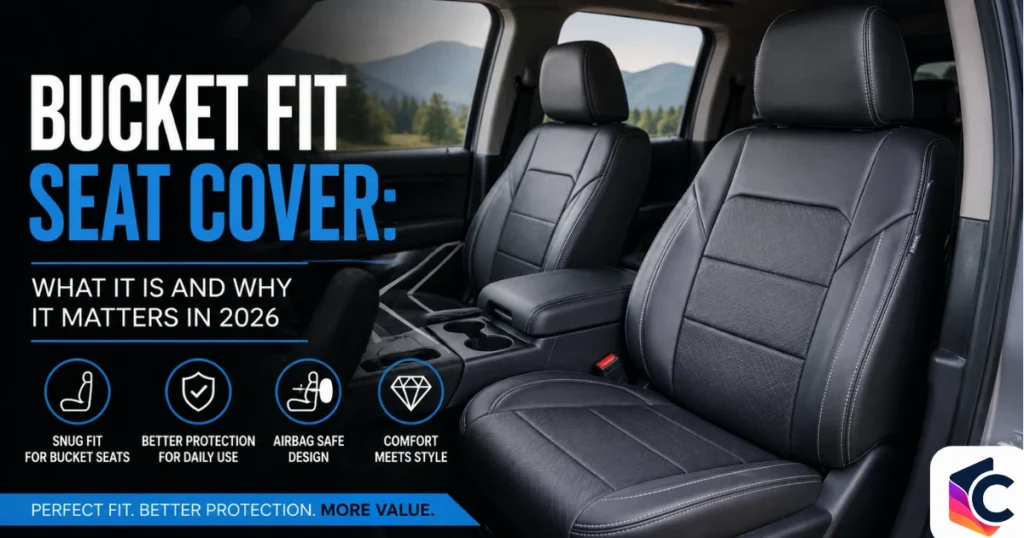
A bucket fit seat cover is a seat cover manufactured to the exact shape and dimensions of a specific bucket seat, rather than a one-size-fits-most design. It’s made for seats with independent left and right cushions, raised side bolsters, and integrated headrests, common in sport, performance, and mid-to-high trim vehicles.
The term “bucket” describes the seat shape itself: a scooped, contoured design that cradles the driver or passenger on both sides, as opposed to a flat bench seat shared by multiple people. A bucket fit cover is engineered to follow every curve of that shape, including the bolsters, seams, and any side airbag panel.
How Bucket Fit Seat Covers Work
Bucket fit covers are built using seat-specific patterns, usually derived from measuring the actual seat or the manufacturer’s factory specs. The process has three parts.
Pattern matching: The manufacturer maps the exact width, height, and bolster shape of a specific seat model, sometimes down to the trim level.
Panel construction: The cover is cut and sewn as separate panels for the seat back, cushion, bolsters, and headrest, then joined with reinforced seams so it sits flush instead of stretching over the frame.
Airbag compatibility: For seats with side airbags, the cover includes a seam designed to tear open under airbag deployment force, so the cover doesn’t block the airbag or delay its release.
| Stage | What Happens | Why It Matters |
|---|---|---|
| Pattern matching | Seat dimensions are recorded per model/trim | Ensures no gaps or excess fabric |
| Panel construction | Cover is sewn in separate fitted sections | Prevents bunching around bolsters |
| Airbag compatibility | Seam designed to release under airbag force | Keeps safety systems functional |
Bucket Fit vs. Universal Seat Covers
A bucket fit cover is built for one seat shape; a universal cover is built to loosely fit many. That’s the core difference, and it affects everything from comfort to safety compliance.
Universal covers use elastic hems and generic panel shapes so they can stretch over a wide range of seat sizes. This keeps costs low, but the tradeoff is fit: universal covers commonly bunch around bolsters, ride up during use, and can interfere with side airbag deployment because they aren’t designed with airbag seams.
Bucket fit covers cost more upfront (National Highway Traffic Safety Administration test data on aftermarket seat covers shows airbag-compatible designs require additional certified stitching, NHTSA, 2024) but hold their shape over years of use and are the safer option for any vehicle with side airbags.
Who Needs a Bucket Fit Seat Cover
Anyone with contoured, sport, or performance-style seats benefits most from a bucket fit cover, since these seats have the bolster shapes universal covers can’t match.
Sport and performance car owners: Bolstered seats need a cover that follows the bolster curve exactly, or the cover shifts during hard cornering.
Owners of vehicles with side airbags: Bucket fit covers with certified airbag seams are the only safe option; using a non-certified universal cover can block airbag deployment.
Owners protecting resale value: A properly fitted cover prevents wear patterns and stitching damage to the factory upholstery underneath.
Common Mistakes When Buying a Bucket Fit Seat Cover
- Matching by car model only: Fitment depends on the seat’s specific shape and trim level, not just the vehicle’s make and model. The same car can have two different seat shapes across trims.
- Ignoring airbag seams: A cover without a certified tear-away seam over a side airbag can delay or block deployment in a crash.
- Skipping seat measurements: Bolster width and headrest attachment style vary even within one seat family. Measure before ordering, or use the manufacturer’s seat-specific catalog number.
Frequently Asked Questions About Bucket Fit Seat Covers
What is a bucket fit seat cover?
It’s a seat cover custom-patterned to match the exact shape of an individual bucket seat, including its bolsters, cushion contour, and headrest, instead of stretching loosely over any seat like a universal cover does.
How does a bucket fit seat cover work?
Manufacturers measure the specific seat model and cut separate fitted panels for the back, cushion, and bolsters. These panels are sewn with reinforced seams, and for airbag-equipped seats, a certified seam is added that tears open under deployment force.
What is the difference between a bucket fit and a universal seat cover?
A bucket fit cover is built for one exact seat shape and holds its position without bunching. A universal cover uses stretch fabric and elastic hems to fit a range of seat sizes, but tends to shift, bunch around bolsters, and may lack airbag-safe seams.
Who should use a bucket fit seat cover?
Owners of sport, performance, or contoured bucket seats, and anyone with side-mounted airbags, since only bucket fit covers with certified seams keep those airbags functional.
What are the benefits of a bucket fit seat cover?
A precise fit that doesn’t shift or bunch, airbag compatibility on equipped seats, and better long-term protection of the factory upholstery underneath.
Key Takeaways
- Bucket fit seat covers are patterned to a specific seat’s shape, not a general car model.
- They cost more than universal covers but last longer and stay in place.
- Side airbag compatibility is a safety requirement, not just a comfort feature.
- Measure the seat or use a seat-specific catalog number before buying.
Sources:

Leave a Reply