
Published: August 11, 2026 | Last updated: August 11, 2026 | 9 min read
TL;DR
- Standard seat covers usually block ventilated seats because solid fabric or vinyl seals the perforations the fans blow through.
- Covers made from spacer mesh, perforated leatherette, or laser-cut panels that line up with your seat’s vent zones keep the airflow working.
- Custom or semi-custom covers fit tighter and align with vent zones more accurately than universal covers, which matters more than price.
- If your seat has a side airbag, only a cover with a certified tear seam over that panel is safe to install.
- Thick materials like neoprene or solid vinyl are the most common reason ventilated seats stop working after a cover goes on.
Do Seat Covers Work With Ventilated Seats?
Yes, but only if the cover is built to let air pass through it. <cite index=”8-1″>Ventilated seats use small fans built into the cushion and backrest that push air through the seat to cool the occupant, and the cover needs to be breathable enough not to block that airflow.</cite> A cover made from solid vinyl or thick padded fabric will sit over the perforations and stop the air before it reaches you.
The deciding factor is the cover’s material and how well its openings line up with your seat’s actual vent zones, not whether it’s labeled “universal” or “premium.” <cite index=”5-1″>Standard universal-fit covers often seal off the perforations in ventilated seats, while covers built specifically for compatibility use laser-cut holes or mesh panels positioned over the active vent areas.</cite>
How Ventilated Seats Actually Work
Ventilated seats pull heat and moisture away from your body instead of just cooling the cabin air around you. Small electric fans sit inside the seat cushion and backrest, and they push or draw air through tiny perforations in the seat surface.
That airflow only works if nothing blocks the holes. A factory leather or fabric seat has perforations built into the original upholstery. The moment you add a cover, that surface is no longer the one the air was designed to pass through, so the cover’s own breathability becomes the limiting factor.
This is different from heated seats, which warm you through conduction rather than airflow. A thick cover slows down heat transfer but usually doesn’t stop it completely. A thick cover on a ventilated seat can stop the cooling effect almost entirely, because air has to find a physical path through the material.
Materials That Keep the Cooling Working
Spacer mesh is the material most repeatedly recommended for ventilated seats because <cite index=”8-1″>its open weave design allows air to pass through freely while still offering some protection and comfort.</cite> It’s a 3D fabric with a raised structure that keeps the surface from sitting flat against the seat, which helps air move even where perforations aren’t perfectly aligned.
Perforated leatherette is the second common option. It looks and feels closer to leather but has holes punched or laser-cut into it. <cite index=”11-1″>This lets air circulate through to the seat below while keeping a leather-like appearance, unlike smooth leatherette that has no way for air to pass through.</cite>
Stretch fabric and spandex blends are thin enough that they don’t add meaningful resistance to airflow. <cite index=”11-1″>These materials are flexible and thin, so they don’t block the fans the way heavier fabrics do.</cite> The tradeoff is durability. Thin stretch fabric wears faster than mesh or leatherette under daily use.
| Material | Airflow Impact | Best For |
|---|---|---|
| Spacer mesh | Minimal, open weave | Daily drivers who want maximum cooling |
| Perforated leatherette | Minimal if holes align with vents | Buyers who want a leather look |
| Stretch fabric/spandex | Minimal, very thin | Budget-conscious buyers, short-term use |
| Neoprene | Noticeable reduction | Heated seats more than ventilated seats |
| Solid vinyl/PVC | Blocks airflow almost entirely | Avoid on ventilated seats |
Materials and Designs That Block the Cooling
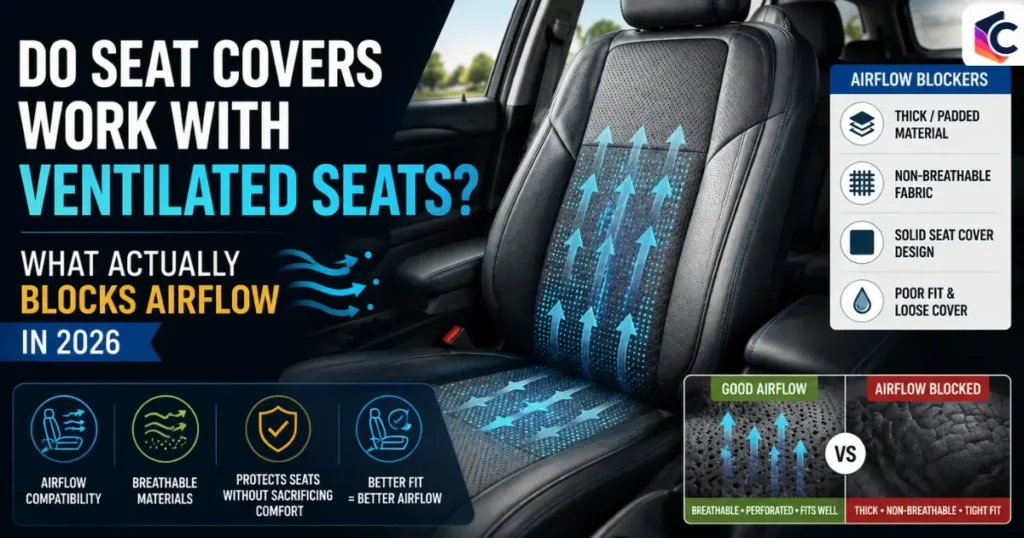
Solid vinyl and PVC are the most common culprits behind a ventilated seat that stops working after a cover goes on. These materials have no natural openings, so unless the cover was engineered with cut vent panels, the fans are pushing air into a dead end.
Neoprene sits in a gray zone. <cite index=”11-1″>It’s thicker than most breathable options, and while it still lets some heat through for heated seats, ventilated seats tend to be noticeably less effective underneath it.</cite> If you drive somewhere hot and rely on seat cooling daily, neoprene is a downgrade even if it’s a comfortable, snug fit.
Fit matters as much as material. <cite index=”12-1″>A cover that’s thick, padded, or wrinkled traps heat against the seat and weakens the airflow even if the fabric itself is technically breathable.</cite> Loose universal covers that bunch up over the cushion are one of the most overlooked reasons ventilated seats feel weaker after a cover installation, even when the material is labeled as vent-friendly.
Airbag Compatibility Is a Separate, Non-Negotiable Check
If your vehicle has a side or center airbag built into the seat, cooling performance isn’t the only thing at stake. <cite index=”13-1″>When a side or center airbag activates, the seat cover has to open too, typically through a seam designed to tear at that exact spot, and a cover without that feature can prevent the airbag from deploying fast enough.</cite>
There’s no single US federal certification standard specifically for aftermarket seat covers, but that doesn’t mean the risk is theoretical. <cite index=”14-1″>Seat covers count as motor vehicle equipment under federal law, which means manufacturers are still responsible for keeping them free of safety-related defects and for issuing recalls if a defect is found.</cite>
Look for a cover that names its airbag feature specifically, such as a labeled tear seam or a separate bolster panel over the airbag zone, rather than a general “airbag compatible” claim with no detail on how it works. <cite index=”19-1″>The release seam needs to line up with the factory airbag deployment seam for your specific vehicle, and it should use lighter thread than the rest of the cover so it splits at the right force.</cite> A generic universal fit is the wrong choice for any seat with a side airbag.
Common Mistakes to Avoid
- Buying based on the word “breathable” alone: Marketing copy uses this word loosely. Check for spacer mesh, perforated leatherette, or laser-cut vent panels by name, not just the word “breathable” in a product title.
- Choosing universal fit for a car with side airbags: Universal covers rarely have a tear seam positioned correctly for your specific seat. Buy a cover listed for your exact make, model, and year.
- Ignoring wiring clearance: Ventilated seats have electrical connectors under the cushion for the fan motor. A cover without slits or grommets for these wires can pinch them during installation.
- Assuming thicker means more protective: A thicker cover does protect the seat better from spills and wear, but it’s also the most likely to choke off airflow. There’s a real tradeoff here, not a free upgrade.
Frequently Asked Questions About Seat Covers and Ventilated Seats
Do seat covers stop ventilated seats from working?
They can, but only if the material is solid or thick enough to block airflow. Covers made from spacer mesh or perforated leatherette are designed to let air pass through, so the cooling effect stays close to what the seat delivers uncovered.
What is the best material for seat covers on ventilated seats?
Spacer mesh is the most commonly recommended option because of its open weave structure. Perforated leatherette is the next best choice if you want a leather look without sacrificing airflow.
Are seat covers safe on seats with side airbags?
Only if the cover has a certified tear seam or a separate panel over the airbag zone that matches your vehicle’s factory design. A generic universal cover without that feature can interfere with deployment.
Do I need a custom-fit cover, or will a universal one work?
Custom and semi-custom covers align more accurately with your seat’s actual vent zones and airbag seams. Universal covers are cheaper but more likely to shift, bunch, or misalign with perforations, which weakens both cooling and safety.
Will a seat cover void my car’s warranty?
A seat cover itself typically doesn’t void your vehicle warranty, since it’s an external accessory rather than a modification to the seat’s internal components. Check your specific manufacturer’s warranty terms, and avoid covers that require cutting or permanently altering the factory seat.
Can heated and ventilated seats use the same cover?
Often yes, if the cover is thin and breathable enough for both functions. Thick materials like neoprene reduce ventilation more than they reduce heating, so a cover that works for heated seats isn’t automatically a good match for ventilated ones.
Key Takeaways
- Ventilated seats need airflow through the cover’s material, not just around it, so the fabric choice determines whether cooling still works.
- Spacer mesh and perforated leatherette are the two materials most consistently recommended for keeping airflow intact.
- Side and center airbags require a cover with a proper tear seam matched to your vehicle. This is a safety issue, not a comfort preference.
- Fit quality (custom vs. universal) affects both cooling performance and airbag safety, so it’s worth prioritizing over price alone.

Leave a Reply