
[Published: August 25, 2026 | Last updated: August 25, 2026] | 9 min read
TL;DR
- A tonneau cover can improve fuel economy, but the real-world gain is usually 1-5%, not the 15% some sellers claim.
- The only controlled study to show a large number is a 1997 Western New England College water-tunnel test, which measured a 12% drag reduction, not a direct MPG figure (Western New England College, 1997).
- Ford’s own aerodynamics testing found an 8-10% drag reduction on the F-150, translating to roughly 2% better EPA-cycle fuel economy and about 5% at steady highway cruising speed (Ford Motor Company, 2007).
- Not every test agrees. Consumer Reports and AmericanTrucks both recorded a small mileage decrease with a cover installed, likely due to the added weight (Consumer Reports, 2013; AmericanTrucks, 2024).
- If gas savings are your only reason to buy one, the payback period is long. Buy a tonneau cover for security and weather protection, and treat any fuel savings as a bonus.
What Is a Tonneau Cover and Does It Save Gas?
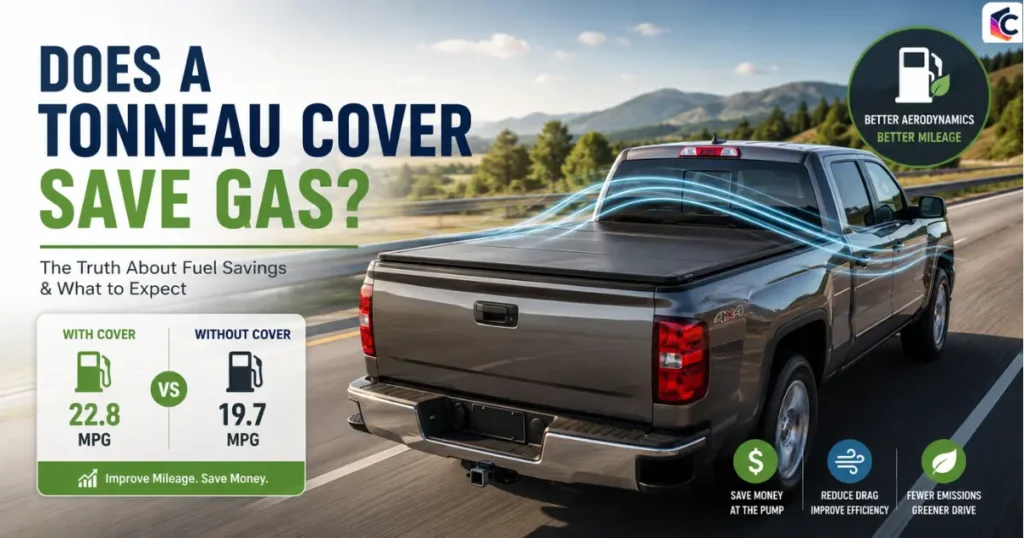
A tonneau cover is a rigid or soft panel that seals off an open pickup truck bed. It does save gas in most tests, but the effect is small and inconsistent across truck models, speeds, and cover types.
The idea is straightforward. An open truck bed creates turbulence, or drag, that the engine has to work against. A cover smooths the airflow over the bed, which can reduce that drag. Less drag means the engine burns less fuel to hold the same speed. In practice, the actual mileage gain ranges from a small decrease to about a 5% improvement, depending on the study, the truck, and how fast you’re driving.
How a Tonneau Cover Affects Aerodynamics
A tonneau cover changes airflow by giving the truck bed a flat, closed surface instead of an open box that traps swirling air.
At low speeds and around town, aerodynamic drag barely matters. The engine spends most of its energy overcoming rolling resistance and stop-and-go acceleration, not wind resistance. At highway speeds, above roughly 55 mph, drag becomes a much bigger share of total fuel use. That’s why nearly every study on tonneau covers shows a bigger benefit on the highway than in city driving.
Cover material matters too. A rigid, flat hard cover tends to reduce drag more consistently than a soft roll-up or tri-fold cover, because the hard surface holds its shape at speed instead of flexing (AmericanTrucks, 2024).
What the Studies Actually Found
The Western New England College Water-Tunnel Study (1997)
Engineering students at Western New England College used a water tunnel, a lab tool that models airflow using water instead of wind, to test a tonneau cover’s effect on drag. They measured a 12% reduction in drag with the cover installed (Western New England College, 1997).
This is the number most tonneau cover retailers cite. It’s a real, award-winning study, but it measured drag, not miles per gallon. Drag reduction and fuel economy improvement are related but not equal, since fuel economy also depends on engine load, gearing, and speed.
Ford’s Wind Tunnel and Fleet Testing
Ford engineer Jack Williams reported that tonneau covers reduced aerodynamic drag on the F-150 by 8-10%. Ford translated that into roughly a 2% improvement in combined EPA city/highway fuel economy, and closer to 5% at a steady highway cruising speed (Ford Motor Company, 2007).
That gap between the 8-10% drag figure and the 2% real-world MPG figure is the clearest illustration of why “drag reduction” and “gas savings” aren’t the same claim.
SEMA’s Wind Tunnel Testing (2007)
The Specialty Equipment Market Association ran its own wind tunnel tests on tonneau covers across multiple truck configurations and measured a 5.73% reduction in drag (SEMA, 2007). Critics have pointed out that SEMA’s test truck had its side mirrors removed, which lowers real-world drag and may inflate the result compared to how most people actually drive.
MythBusters, Episode 64 (2006)
The Discovery Channel show retested pickup aerodynamics after viewer feedback on an earlier episode. Using an electronic fuel-flow meter, the team found that a mesh tailgate performed best, closed tailgate came next, and a hard tonneau cover performed about the same as driving with the tailgate simply closed, not meaningfully better (MythBusters/Discovery Channel, 2006).
This result is one truck, on one stretch of road, with one type of cover, so treat it as a data point rather than a verdict.
Consumer Reports and Real-World Owner Tests
Consumer Reports tested a covered bed against an open one and found fuel economy actually decreased slightly with the cover on, a result it repeated in a follow-up test roughly a decade later. AmericanTrucks ran its own real-world test and saw MPG drop from 22.3 to 21.4 with a cover installed (Consumer Reports, 2013; AmericanTrucks, 2024). The most likely explanation in both cases is the added weight of the cover itself, especially with heavier hard-shell designs.
On the other side, Forbes tested a Ram TRX and reported highway mileage climbing from roughly 12 mpg to a range of 12.5-14.7 mpg after installing a cover, depending on the route (Forbes, 2025, as reported by Jalopnik).
Tonneau Cover Type and Its Effect on MPG
| Cover Type | Typical Weight | Aerodynamic Effect | Best Use Case |
|---|---|---|---|
| Soft roll-up | Light | Minimal, can flex at speed | Budget buyers, light-duty use |
| Soft tri-fold | Light to moderate | Moderate, seams can create small gaps | Occasional highway driving |
| Hard folding | Moderate to heavy | More consistent drag reduction | Frequent highway driving |
| Retractable hard | Heavy | Best aerodynamics when closed | Daily highway commuters who want a flush profile |
A lighter cover reduces the risk that added weight cancels out any aerodynamic gain. A heavier hard cover reduces drag more reliably but adds more mass for the engine to move.
Does the Fuel Savings Actually Pay for the Cover?
In most cases, no, not on fuel savings alone. A tonneau cover typically costs $200 to $1,100. At a realistic 2-5% highway MPG improvement, it can take 10,000 to 40,000 miles of mostly highway driving to recoup the purchase price in fuel savings, depending on your truck’s baseline MPG and local gas prices.
If you drive mostly in town, the payback period stretches out even further, since drag reduction barely matters at low speeds. Buyers looking purely for gas savings will generally get a faster return from basic maintenance, like keeping tires at the correct pressure, which the U.S. Department of Energy estimates can improve fuel economy by up to 3% on its own.
Common Mistakes That Cancel Out Any Gas Savings
- Buying a heavy hard cover for occasional use: The added weight can offset the aerodynamic benefit if you mostly drive short, low-speed trips.
- Leaving the tailgate down with a cover installed: This reintroduces turbulence and can undo the drag reduction the cover was providing.
- Expecting city driving to show a difference: Aerodynamic drag has the least impact below highway speeds, so don’t judge a cover’s value on your commute alone.
- Ignoring installation gaps: A poorly fitted cover with visible gaps at the edges won’t seal airflow the way a snug-fitting cover does.
Frequently Asked Questions About Tonneau Covers and Gas Mileage
Does a tonneau cover save gas?
It can, though the effect is usually modest. Independent tests show results ranging from a slight MPG decrease to about a 5% improvement, with the biggest gains showing up at highway speeds (SEMA, 2007; Ford Motor Company, 2007).
How much gas does a tonneau cover actually save?
Most credible tests put the real-world improvement between 1% and 5% at highway speeds. Manufacturer claims of 10-15% are based on drag reduction figures, not measured fuel economy.
Do hard tonneau covers save more gas than soft ones?
Hard covers tend to reduce drag more consistently because they hold a flat shape at speed, but they also weigh more, which can reduce or cancel the benefit in stop-and-go driving (AmericanTrucks, 2024).
Is it better to drive with the tailgate up or down for gas mileage?
Tailgate up is generally more fuel-efficient than tailgate down on most full-size trucks, based on both MythBusters testing and Ford’s own aerodynamic data. A tonneau cover with the tailgate up typically performs about the same as, or slightly better than, tailgate up alone.
Will a tonneau cover pay for itself in fuel savings?
Rarely on fuel savings alone. At a realistic 2-5% MPG gain, most covers take tens of thousands of highway miles to pay for themselves in gas. Most buyers get more value from the cargo security and weather protection than from the fuel savings.
Key Takeaways
- Real-world gas savings from a tonneau cover are modest, typically 1-5% at highway speeds, and can even be negative in city driving.
- The often-quoted 12-15% figures come from drag reduction studies, not measured fuel economy.
- Cover weight matters as much as shape. A light cover on a highway-heavy driver sees the best results.
- Buy a tonneau cover for security and weather protection first. Treat any gas savings as a secondary benefit.
Sources
- Peragon, “Do Tonneau Covers Save Gas?” — https://www.peragon.com/blog/do-tonneau-covers-save-gas/
- AmericanTrucks, “How Tonneau Covers Improve Fuel Efficiency and Save You Money” — https://www.americantrucks.com/do-tonneau-covers-save-gas.html
- Jalopnik, “Can A Tonneau Cover Really Save You Money On Gas?” — https://www.jalopnik.com/1821343/truck-tonneau-covers-save-gas/

Leave a Reply