
[Published: 11 October 2026 | Last updated: 11 October 2026] | 7 min read
TL;DR
- You usually cannot build a garage over a drain cover (manhole) on a shared or public sewer. Building regulations bar extensions over manholes and inspection chambers on sewers serving more than one property (Ipswich Borough Council, 2026).
- A build over agreement (BOA) is needed for work within 3 metres of a public sewer or 1 metre of a public lateral drain (Thames Water, 2026).
- A new detached garage generally needs the sewer diverted, because a BOA does not cover new standalone buildings (Thames Water, 2026).
- Skipping approval is risky. Without an agreement, the water company can demolish a structure to reach the sewer (Timms Law, 2026).
- Your first step is to find out who owns the drain, then contact the water company before any design work.
Can You Build a Garage Over a Drain Cover?
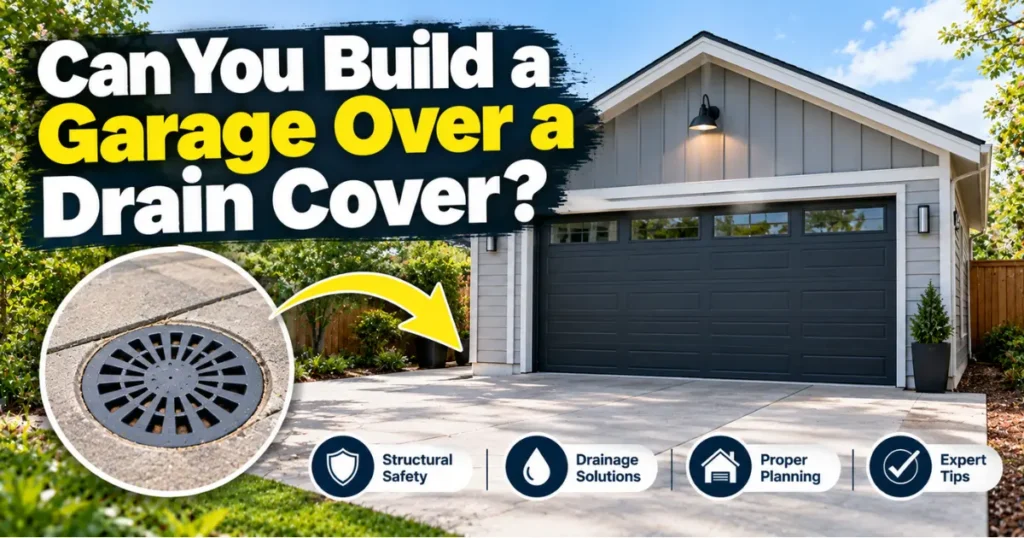
In most cases, no. A drain cover on a public or shared sewer must stay accessible, so you cannot put a garage floor or wall over it. The rules are looser for a private drain serving only your home, but you still need building control approval.
A drain cover is the lid of a manhole or inspection chamber, the access point used to clear blockages and inspect pipes. Water companies treat these as access points they must always reach.
The answer depends on three things: who owns the drain, what type of garage you want, and where the cover sits.
| Situation | Usually allowed? | What you need |
|---|---|---|
| Detached garage over a public sewer | No, sewer is normally diverted | Diversion application to the water company |
| Attached garage (extension) near a public sewer | Sometimes, if the cover stays clear | Build over agreement plus Full Plans building control |
| Garage over a manhole on a shared sewer | No | Redesign or relocate the garage |
| Garage near a private drain serving only your home | Often, with care | Building control check |
Who Owns the Drain Under Your Garage Plot?
Ownership decides your options. Since October 2011, responsibility for many previously private sewers moved to regional water companies (Oldham Council, 2011). A drain that serves only your house is yours up to the boundary. Past the boundary it becomes a public lateral drain owned by the water company (Thames Water, 2026).
Check your property deeds and ask the water company for its sewer records. A quick CCTV drain survey also shows where pipes run.
If two or more properties share the pipe, treat it as a sewer. That means the water company has a say in what you build.
What Do Building Regulations Say About Building Over a Manhole?
Building regulations say you should not build an extension over a manhole, inspection chamber, or other access fitting on a sewer serving more than one property. This comes from Approved Document H4, as summarised by Ipswich Borough Council (2026).
The same council states that work over or close to a public sewer cannot go through a Building Notice. You must deposit Full Plans instead.
Special foundations may also be required. These protect the pipe and your building from settlement.
What Is a Build Over Agreement and When Do You Need One?
A build over agreement (BOA) is a legal contract between you and your water company. It confirms your work will not damage the sewer and that the company keeps access for repairs. Thames Water says you likely need one when building within 3 metres of a public sewer or within 1 metre of a public lateral drain (Thames Water, 2026).
Planning permission does not replace a BOA. Thames Water states that planning approval does not permit you to build over a sewer or drain (Thames Water, 2026).
Some extensions qualify for a free self-certified BOA. The sewer must be 150mm (6 inches) or smaller, and no manhole can need moving (Thames Water, 2026).
Why a Detached Garage Is Harder Than an Extension
A detached garage is treated as a new building, and water companies prefer to divert the sewer instead of agreeing to build over it. Thames Water says new carports and sheds not attached to your property need a sewer diversion application, not a BOA (Thames Water, 2026).
Diversion costs more and takes longer. It means rerouting the pipe around your planned footprint.
An attached garage counts as an extension to an existing property. That route gives you a better chance of a BOA, as long as the drain cover stays outside the walls and slab.
Can You Cover a Drain Cover With a Removable Slab or Sealed Lid?
Rules differ by drain type. On a public sewer, Thames Water does not permit a manhole under a building, even a double-sealed one, because of the risk of internal flooding and odours (Curchods, 2026).
Some general advice sites say water companies may accept an easily removable cover inside a floor plan (Gedling Eye, 2026). Treat that as a case-by-case point. Get written confirmation from your water company before relying on it.
For a private drain, building control may accept a sealed, accessible chamber. Ask them before you pour concrete.
What Happens if You Build Without Permission?
Without a BOA, the water company has a legal right to enter your land and reach the sewer, even if that means demolishing what you built (Timms Law, 2026). Companies try to avoid this, but the risk stays with you.
In an extreme case of serious flooding or drainage failure with no agreement in place, Thames Water says it can take down the building (Curchods, 2026).
Selling is the other problem. Buyers’ solicitors and mortgage lenders ask for a BOA. If none exists, the seller usually commissions a CCTV survey and gets a comfort letter from the water company (Timms Law, 2026).
What Are Your Options if the Drain Cover Is in the Way?
You have four realistic options, listed from cheapest to most expensive:
- Move the garage footprint so the drain cover and a working strip around it stay outside the building.
- Switch to an attached design and apply for a BOA.
- Ask the water company to divert the sewer, then build.
- Raise or relocate the manhole, which usually needs water company approval and may rule out the self-certified route.
Start with a site plan marking every cover and pipe run. Then ask a drainage engineer or architect to test each option against the 3 metre and 1 metre zones.
Steps to Take Before You Build a Garage Near a Drain
- Identify every drain cover on your plot and confirm if it serves one property or several.
- Request sewer maps from your water company.
- Contact your local authority building control team about Full Plans.
- Apply for a BOA or diversion before any groundwork starts.
- Keep all approvals for the property sale file.
Frequently Asked Questions About Building a Garage Over a Drain Cover
Can you build a garage over a manhole cover?
Not on a public or shared sewer. Approved Document H4 advises against building over manholes and inspection chambers on sewers serving more than one property (Ipswich Borough Council, 2026). On a private drain, speak to building control first.
Do I need permission to build over a drain?
Yes, if the drain is within 3 metres of a public sewer or 1 metre of a public lateral drain. You need a build-over agreement from the water company before work begins (Thames Water, 2026).
How close can you build a garage to a public sewer?
Within 3 metres of a public sewer, you must seek water company approval. A detached garage may need the sewer diverted instead of a BOA (Thames Water, 2026).
Does planning permission cover building over a drain?
No. Planning permission and a build over agreement are separate approvals. Thames Water confirms planning consent does not allow you to build over a sewer (Thames Water, 2026).
What if my existing garage was built over a drain with no agreement?
Get a CCTV survey of the sewer and send it to the water company. They may issue a comfort letter that satisfies buyers and lenders (Timms Law, 2026). It does not remove the underlying legal risk, so ask a solicitor.
Can I move a drain cover to fit a garage?
Sometimes. Relocation needs water company consent and affects eligibility for the free self-certified BOA (Thames Water, 2026).
References
- Thames Water – Do I need a build over agreement? https://www.thameswater.co.uk/help/home-improvements/do-i-need-a-build-agreement
- Ipswich Borough Council – Building over or near sewers: https://www.ipswich.gov.uk/planning-and-building-control/building-control/pre-application-advice/building-over-or-near-sewers
- Timms Law – What is a Build Over Agreement? https://www.timms-law.com/conveyancing-what-is-a-build-over-agreement

Leave a Reply