
[Published: August 13, 2026 | Last updated: August 13, 2026] | 8 min read
TL;DR
- Measure your truck bed length from the inside of the bulkhead (front wall) to the inside of the tailgate, not the outside of the truck.
- Standard bed lengths fall into three groups: short beds (5.5-5.8 ft), standard beds (about 6.5 ft), and long beds (around 8 ft), though exact numbers vary by brand (MyCarQuest.com, 2025).
- Most tonneau covers are sold by bed length category (5.5′, 6.5′, 8′), so a measurement within an inch or two of the standard sizes is usually enough – exact-to-the-decimal precision matters more for custom or hard-fold covers.
- You’ll need a tape measure, a notepad, and about 10 minutes. No tools required beyond that.
- Always confirm your bed length against your truck’s door-jamb sticker or manufacturer spec sheet before ordering, since a few inches of difference can mean the cover won’t seal.
What You Need Before You Start
- A tape measure at least 8 feet long (a standard 25-foot tape measure works fine)
- A notepad or your phone to record numbers as you go
- Access to both sides of the truck bed, tailgate closed
- Your truck’s year, make, model, and trim (check the door-jamb sticker if you’re not sure)
Step 1: Confirm Your Bed Length Category First
Before you pull out the tape measure, check your truck’s spec sheet or door-jamb sticker for the factory-listed bed length. This gives you a target number to measure against, so you’ll know right away if your manual measurement is off.
Short beds typically run 5.5 to 5.8 feet, standard beds run around 6.5 feet, and long beds stretch to about 8 feet, though the exact figure depends on the manufacturer (MyCarQuest.com, 2025). Ford’s short bed, for example, measures roughly 5 feet 5 inches to 5 feet 8 inches, while the Chevrolet Silverado 1500’s standard bed measures 79.4 inches, or 6 feet 6 inches (OffRoadTents.com, 2025).
Step 2: Measure the Bed Length (Bulkhead to Tailgate)
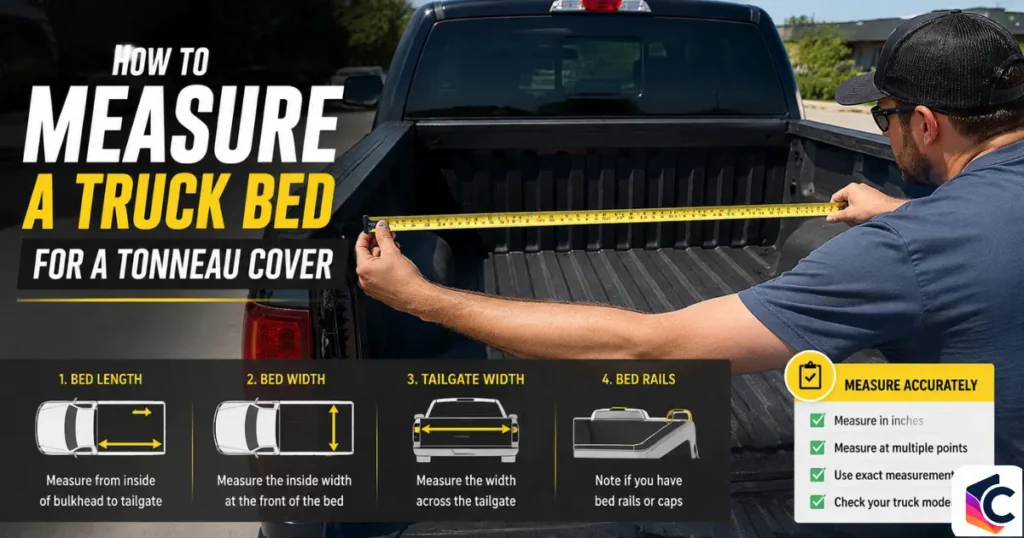
With the tailgate closed, place your tape measure at the inside wall of the bulkhead, the vertical panel right behind the cab. Run the tape in a straight line to the inside of the closed tailgate.
Measure the inside of the bed, not the outside. The truck’s bodywork and wheel-well trim can add several inches to an outside measurement, which will throw off your cover order (CarParts.com, 2025). Record this number in inches. Round to the nearest half-inch if the tape falls between markings.
Step 3: Measure the Bed Width at Three Points
Bed width isn’t uniform along the length of most trucks because of the wheel wells, so take three separate measurements:
- Widest point – measure from the top edge of one bed rail to the top edge of the other, at the widest open section (usually near the front or back of the bed).
- Narrowest point – measure between the wheel wells, where the bed is at its tightest.
- Rail-to-rail at the tailgate – measure across the opening where the tailgate meets the bed.
Most full-size truck beds measure between 50 and 65 inches wide overall, with narrower measurements between the wheel wells (J.C. Lewis Ford Statesboro, 2026). Soft roll-up and folding tonneau covers typically use the rail-to-rail measurement, so that’s the one to prioritize if your cover’s install guide doesn’t specify.
Step 4: Measure Bed Depth (If Your Cover Sits Inside the Rails)
Depth matters most for low-profile hard covers and any cover that sits inside the bed rather than clamping over the top rail. Measure straight down from the top edge of the bed rail to the floor of the bed, at the same point on both sides.
Note any bed liner thickness separately. A spray-in or drop-in liner can reduce usable depth by half an inch or more, which matters for covers with tight tolerances.
Step 5: Check the Rail Style and Stake Pocket Locations
Tonneau covers clamp onto the bed rail in different ways depending on the rail’s shape (rounded, flat, or with raised stake pockets). Run your hand along the top of the rail and note:
- Whether the rail is flat, curved, or has a raised lip
- Where the stake pockets sit relative to the front and rear of the bed
- Whether your truck has factory-installed bed rail caps, which can add height the cover needs to clear
This step catches most of the fitment issues that a length-and-width measurement alone will miss.
Step 6: Cross-Check Against the Manufacturer’s Fitment Chart
Take your recorded numbers and compare them against the tonneau cover manufacturer’s fitment chart for your exact year, make, model, and cab configuration. Bed lengths aren’t always consistent across trims of the same truck. Ford’s short bed can run 5.5 feet while a Chevy or GMC short bed comes in closer to 5.8 feet, and Toyota uses its own set of dimensions entirely (MyCarQuest.com, 2025).
If your measurement lands between two listed sizes, order for the size your VIN-decoded spec sheet confirms, not the size your tape measure rounds to.
Common Problems and How to Fix Them
| Problem | Likely Cause | Solution |
|---|---|---|
| Cover doesn’t sit flush at the tailgate | Measured bed length from the outside of the truck | Re-measure from the inside of the bulkhead to the inside of the tailgate |
| Cover won’t clamp onto the rail | Rail has a raised lip or factory cap not accounted for | Re-check rail shape and order a cover rated for that rail style |
| Cover sags or bows in the middle | Width measured only at one point instead of three | Re-measure at the widest point, narrowest point, and tailgate opening |
| Cover doesn’t seal at the front | Bed liner added extra height or depth not measured | Re-measure with the liner installed, not the bare bed |
| Ordered wrong size despite measuring | Trim-level bed length differs from the general model spec | Confirm the exact length using your VIN, not just the model name |
Frequently Asked Questions
How do I measure my truck bed for a tonneau cover?
Measure the inside of the bed from the bulkhead to the inside of the closed tailgate for length, then measure width at the widest point, narrowest point (between wheel wells), and at the tailgate opening. Round to the nearest half-inch.
Should I measure the inside or outside of the truck bed?
Always measure the inside of the bed. The outside bodywork and wheel-well trim can add several extra inches, which will result in ordering the wrong size cover (CarParts.com, 2025).
What is the standard truck bed length?
Standard beds run around 6.5 feet (78-79 inches), short beds run 5.5 to 5.8 feet, and long beds run close to 8 feet, though the exact number depends on the manufacturer and trim (MyCarQuest.com, 2025).
Can I use my truck’s listed spec sheet instead of measuring myself?
Yes, as a starting reference. But confirm it against your own measurement, since trim-level differences and factory options can shift the actual bed length by an inch or more.
Do I need to remove my bed liner before measuring?
No, but measure with the liner in place if you plan to keep it installed. A liner can reduce usable width and depth, and the cover needs to fit over or around it either way.
What if my measurement falls between two standard sizes?
Order based on your VIN-confirmed factory spec, not the number closest to your tape measure. Manufacturers list exact fitment by model and trim for this reason.
Does bed rail shape affect which tonneau cover I need?
Yes. Flat rails, rounded rails, and rails with raised stake pockets or factory caps each require different clamp styles. Check the rail shape in addition to length and width before ordering.
Summary
- Measure bed length from the inside of the bulkhead to the inside of the closed tailgate, never from the outside.
- Take three width measurements: widest point, narrowest point between wheel wells, and the tailgate opening.
- Check depth and rail shape if your cover sits inside the rails or clamps onto a raised lip.
- Confirm your final numbers against the manufacturer’s fitment chart using your exact trim and VIN.
Sources:

Leave a Reply