
[Published: 10 October 2026| Last updated: 10 October 2026] | 6 min read
TL;DR
- You cannot pave over a drain cover so that it is hidden or buried. Every cover must stay visible and reachable for rodding, inspection, and repair.
- You can lay paving up to the cover, or fit a recessed tray cover that takes matching paving so it blends in.
- Covers on a public sewer are the water company’s concern. Thames Water, for example, does not allow manholes on a public sewer to be built over (Thames Water, build over specifications).
- Building within 3 metres of a public sewer needs the water company’s agreement (Richmond Council citing Thames Water, 2020).
- Covered or buried covers can mean a dug-up driveway, a refused sale, or a blocked drain you cannot reach.
Can You Pave Over a Drain Cover?
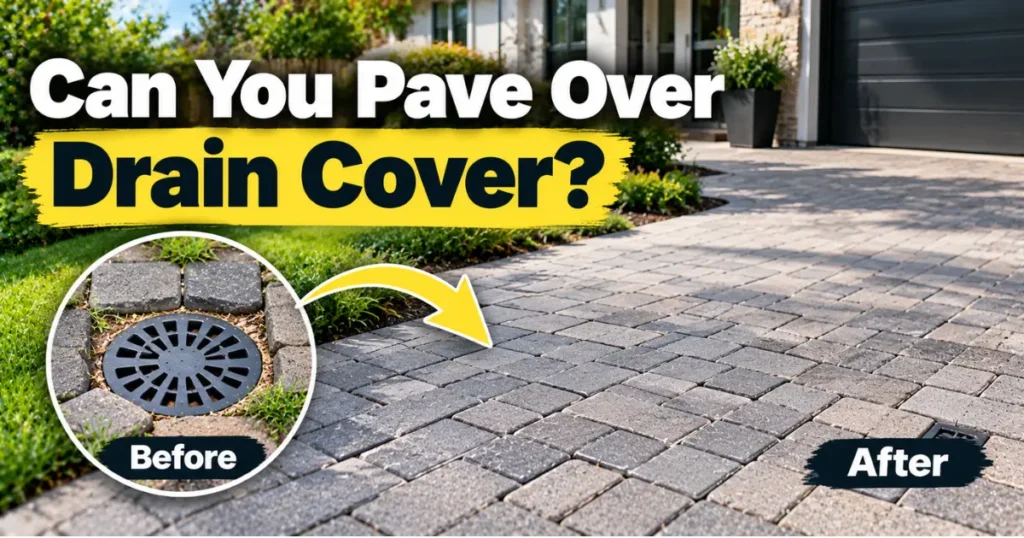
No. A drain cover must stay at the surface where it can be seen and lifted. What you can do is pave neatly around it, or swap it for a recessed tray cover that holds a layer of paving and hides the metal.
A drain cover is the lid over an inspection chamber (also called a manhole). Drain engineers use that chamber to push rods through the pipes and clear blockages. If the lid is buried under slabs, tarmac or block paving, nobody can reach the pipe without breaking up your surface.
Why Drain Covers Must Stay Accessible
A drain cover must stay accessible because the chamber below is the only practical way to clear a blocked pipe or inspect it with a camera. Without that opening, a simple blockage can turn into excavation work.
Think of a drain cover like a stopcock for your water supply. You rarely touch it, but when something goes wrong you need it immediately.
The rule applies on both private and shared drains. On a shared drain, other households depend on that same access point. Once a drain serves more than one property it is usually a public sewer, and the water company becomes responsible for it.
Which Type of Drain Is Under Your Cover?
The type of drain under the cover decides how strict the rules are. A private chamber that serves only your house gives you more freedom than a chamber on a shared or public sewer.
| Type of drain | Who owns it | Can you cover it? |
|---|---|---|
| Private inspection chamber, serves only your home | You | Not buried. A recessed tray cover with paving infill is the usual solution. |
| Shared drain, serves two or more homes | Usually the water company | No. Treat it as a public sewer and contact the water company. |
| Public sewer manhole | Water company | No. Thames Water does not allow manholes on public sewers to be built over (Thames Water, build over specifications). |
| Surface water gully | You or the local authority | No. Paving must slope toward it so water can drain. |
If you are unsure which applies, ask your water company for a drainage record, or ask a drainage firm to trace the pipes.
How to Pave Around a Drain Cover the Right Way
The right way is to keep the cover at the surface, level with the finished paving, and surround it with neat cuts or a recessed tray. This keeps the access point open and still gives a tidy finish.
Paving Expert recommends a recessed tray cover for block paving jobs because the tray takes the same blocks as the surrounding drive (Paving Expert, forum guidance). Follow these steps:
- Locate every cover before you start. Probe the ground or check old plans if any are hidden by soil or turf.
- Decide if the cover height needs to change. Raise or lower the chamber with a new frame so the cover sits level with the new surface.
- Fit a recessed tray cover if you want the cover to blend in. Choose a load rating that suits your use, such as a car drive rather than a garden path.
- Cut paving neatly around the frame. Do not let paving or mortar sit on top of the frame.
- Keep the paving falling away from the cover so water does not pool on it.
- Lift the cover once the job is finished to confirm it opens easily.
What Happens If You Pave Over a Drain Cover Anyway
If you pave over a drain cover, the likely result is that you pay to dig it up. A blocked drain with no access can back up into your home, and a drainage firm will have to break through the new surface to find the chamber.
There are other consequences:
- Water companies can require you to expose the cover again, usually at your cost.
- A buyer’s solicitor or surveyor may flag a hidden chamber and ask for a drainage survey.
- Insurers can dispute a claim if blocked drains cause damage and access was removed.
Do You Need Permission From Your Water Company?
You need permission if the drain is a public sewer or you plan to build within 3 metres of one. Thames Water states you must get its agreement for any building work over or within three metres of a public sewer (Richmond Council citing Thames Water, 2020).
Paving a drive is not the same as building an extension, but a heavy new structure, a retaining wall or a garage near a sewer can still trigger an agreement. This is called a build over agreement.
Thames Water’s published specifications also say no manholes or inspection chambers will be built over under an agreement (Thames Water, build over specifications). Other water companies set their own rules, so check with yours before you start work.
Common Mistakes When Paving Near a Drain Cover
The most common mistake is treating a drain cover as an obstacle to hide rather than an access point to keep. Each of these causes problems later:
- Laying tarmac or concrete over the cover because it is below grade.
- Using a standard cover in a driveway that needs a heavy-duty load rating.
- Forgetting to check whether a neighbour’s drain connects into your chamber.
- Burying a surface water gully, which leaves rainwater with nowhere to go.
- Skipping a call to the water company when the sewer is within 3 metres of the work.
Frequently Asked Questions About Paving Over Drain Covers
Can you pave over a drain cover?
No. You cannot bury it under paving, but you can lay paving up to it or fit a recessed tray cover that takes matching paving. The cover has to stay visible and openable at all times.
Can you cover a manhole with decking or turf?
No. Decking, turf, and soil hide the cover in the same way paving does. Use a removable access panel or a recessed cover that can be opened without tools or demolition.
What is a recessed tray cover?
A recessed tray cover is a drain cover with a deep lid that holds a layer of paving, tiles or gravel. The finish matches the surrounding surface, and the whole lid still lifts out for access.
Who is responsible if a drain cover is paved over?
The property owner is usually responsible for exposing it again. If the chamber is on a public sewer, the water company can ask you to restore access, and you may carry the cost.
How do I know if a drain is private or public?
Check whether the pipe serves only your property. Shared drains are generally public sewers. Your water company holds drainage records, and a drainage survey can confirm the layout.
Do I need planning permission to pave my front garden?
Not usually for permeable paving, but there are limits on impermeable surfaces over a certain size in front gardens in England, so check the Planning Portal. Drain access rules apply either way.
Key Takeaways
- Never bury a drain cover. Keep it visible and level with the finished surface.
- Use a recessed tray cover if you want it to blend in with your paving.
- Shared drains and public sewers have stricter rules, so contact your water company before building near them.
- Check cover height, load rating and falls before the paving goes down.
References
- Thames Water – Build over technical specifications (add publication year): https://www.thameswater.co.uk/media-library/rzcliwpe/build-over-technical-specs.pdf
- Richmond Council (Thames Water building guidance, 2020): https://richmond.gov.uk/services/environment/building_control/building_control_technical_advice_and_guidance/thames_water
- Paving Expert – Drainage and paving guidance: https://www.pavingexpert.com

Leave a Reply