
Published: [Aug 4, 2026] | Last updated: [Aug 4, 2026] | 7 min read
TL;DR
- Yes, most bed extenders work with most tonneau covers, but the fit depends on the extender’s mounting style and the cover’s rail design (RealTruck, 2025).
- Hinged tonneau covers cause the most conflicts because they often can’t latch fully closed with an extender in place (RealTruck, 2025).
- Roll-up, soft folding, hard folding, and retractable covers are generally compatible with hitch-style and tailgate-mounted extenders.
- The main failure point is rail clearance – some covers’ mounting rails sit too far into the bed for the extender to flip between its open and folded positions.
- OEM extenders paired with OEM covers from the same manufacturer have the highest success rate; mixing brands increases the odds of interference.
What Is a Bed Extender and How Does It Interact With a Tonneau Cover?
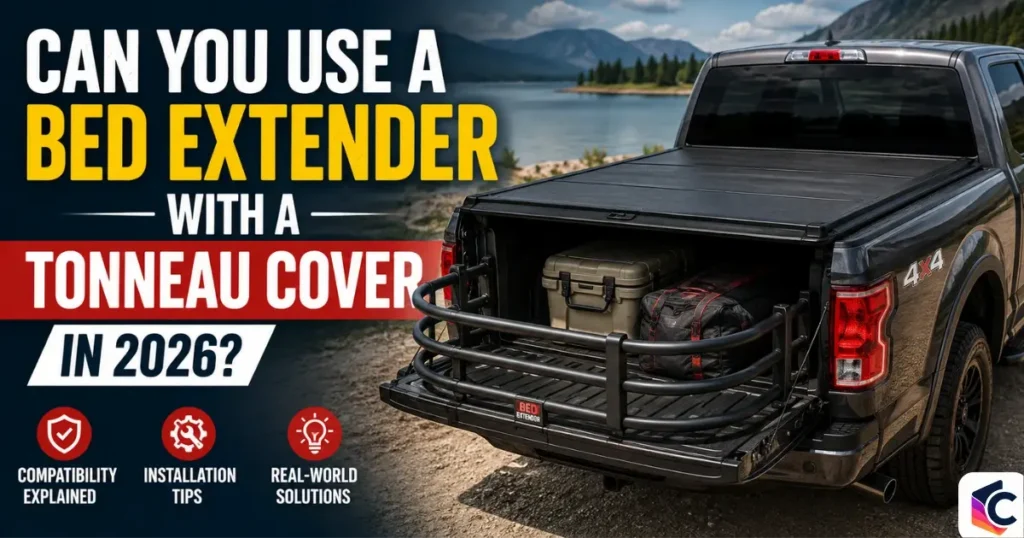
A bed extender is a frame that attaches at the tailgate and swings outward to add several feet of cargo length when the tailgate is down. A tonneau cover is a panel or roll-up cover that seals the top of the bed. The two occupy different zones of the truck bed, which is why they can usually coexist.
The extender mounts low, along the bed rails near the tailgate. The tonneau cover mounts higher, along the top edge of the bed walls. In the “flipped in” or storage position, the extender folds flat against the front of the bed – and that’s where conflicts happen, since the cover’s mounting hardware sometimes sits in the same space.
Which Tonneau Cover Types Work Best With a Bed Extender
Compatibility comes down to how much the cover’s rail hardware protrudes into the bed. Covers with slim, low-profile rails leave more room for the extender to fold in and out.
| Tonneau Cover Type | Typical Compatibility | Why |
|---|---|---|
| Soft roll-up | High | Slim side rails, minimal interference with the extender’s fold path |
| Soft folding | High | Similar low-profile rail design to roll-ups |
| Hard folding | Moderate to high | Slightly bulkier rails, but most extenders still clear them |
| Retractable | Moderate | Rail housing near the bulkhead can be wider, requiring more clearance |
| Hinged | Low | May not latch closed with the extender deployed, since hinged covers need a fully clear bed rail to seal (RealTruck, 2025) |
Retailers such as RealTruck note that bed extenders generally work with roll-up, folding, and retractable covers, while hinged covers are the type most likely to cause a fit problem (RealTruck, 2025).
Why Some Owners Report Fit Problems Anyway
Even with a “compatible” cover type, real-world fitment varies by truck model and extender brand. Several truck owners on model-specific forums report the same underlying issue: the tonneau cover’s mounting rails sit too far into the bed, which blocks the extender from flipping between its outboard and stored positions.
On one Ram 1500 owner’s setup, the factory bed extender couldn’t flip in or out because the tonneau rails extended too far into the bed – a problem specific to that rail width, not to tonneau covers in general. On a Ford F-150, one owner solved a similar clearance issue simply by opening the cover before flipping the extender, since the two parts occupy the same vertical space only when the cover is shut.
The takeaway: cover type matters, but exact rail width and extender design matter just as much. A test fit before final purchase, or checking the manufacturer’s fitment guide, avoids a return.
How to Check Compatibility Before You Buy
Confirm the fit using these steps before ordering either part.
- Identify your extender’s mounting style. Tailgate-hinge extenders fold in and out; hitch-mounted extenders sit in the receiver and don’t interact with the tonneau rails at all.
- Check your cover’s rail profile. Low-profile roll-up or folding rails clear most extenders; hinged and some retractable covers are the tightest fit.
- Look up your specific truck model. Rail width and bed rail design vary by manufacturer and even by model year, so a fit that works on one truck may not work on another.
- Match OEM to OEM where possible. An extender and cover from the same manufacturer are built to the same rail spec, which cuts down on clearance issues.
- Open the cover before flipping the extender. On most setups, the two only conflict when the cover is closed and the extender is being repositioned.
Common Mistakes to Avoid When Pairing a Bed Extender With a Tonneau Cover
- Buying a hinged cover first, extender second: Hinged covers have the highest rate of latch-closure problems with extenders in place, so check fitment before buying if you already own one.
- Assuming all extenders behave the same: Two-piece extenders (that split and fold separately) clear tight rail spacing better than one-piece units.
- Skipping the fitment guide: Manufacturer listings and model-specific forums often flag known rail-clearance issues before you spend the money.
- Ignoring bed liners and mats: A thick spray-in liner or rubber mat can reduce the clearance an extender needs, even when the extender and cover are otherwise compatible.
Frequently Asked Questions About Bed Extenders and Tonneau Covers
Can you use a bed extender with a tonneau cover?
Yes, in most cases. Roll-up, soft folding, hard folding, and retractable covers generally work with tailgate-mounted extenders, though exact fitment depends on the truck model and extender brand (RealTruck, 2025).
Which tonneau cover type is least compatible with a bed extender?
Hinged covers cause the most problems, since they often can’t latch fully closed with an extender deployed (RealTruck, 2025).
Do hitch-mounted bed extenders avoid tonneau cover conflicts entirely?
Yes. A hitch-mounted extender sits in the receiver hitch rather than folding against the bed rails, so it doesn’t interact with the tonneau cover’s mounting hardware.
Will an OEM bed extender fit with an aftermarket tonneau cover?
It depends on the aftermarket cover’s rail width. OEM extenders are built to the OEM cover’s rail spec, so pairing with a different brand increases the chance of interference.
Do I need to open the tonneau cover to use the bed extender?
Usually, yes. Most reported conflicts happen only when the cover is closed while the extender is being flipped between positions – opening the cover first typically resolves it.
Key Takeaways
- Most bed extenders and tonneau covers coexist without issue, especially with roll-up, folding, and retractable cover styles.
- Hinged covers carry the highest risk of a fit problem.
- Confirm rail width and mounting style for your specific truck model before buying, and favor matching OEM parts when possible.
Sources:
- RealTruck, “Tonneau Covers and Compatible Accessories,” 2025 – https://realtruck.com/blog/what-works-with-my-tonneau-cover/
- F150gen14 Forum, “Tonneau cover compatible with bed extender,” 2023 – https://www.f150gen14.com/forum/threads/tonneau-cover-compatible-with-bed-extender.15181/
- Honda Ridgeline Owners Club, “2G OEM Tonneau cover and OEM Bed Extender compatibility,” 2021 – https://www.ridgelineownersclub.com/threads/2g-oem-tonneau-cover-and-oem-bed-extender-compatibility.228324/

Leave a Reply