

TL;DR
- To put on a mattress cover, strip the bed, pull the cover over the top corners first, then work down and smooth out wrinkles.
- Fitted covers take about 5 minutes alone; zippered encasements go on more easily with two people.
- A fitted sheet goes on top of the cover, never under it.
- Wash the cover every 1-2 months, or more often if you have pets or allergies.
What Type of Mattress Cover Do You Have?
Check the label first, because the two main types go on differently. For example, a fitted protector works like a fitted sheet. A zippered encasement wraps the whole mattress and seals shut. A standard protector covers the top and sides of the mattress, while an encasement surrounds the entire mattress. Both are called “mattress covers” in stores, so the product description is the reliable guide.
| Feature | Fitted Protector | Zippered Encasement |
|---|---|---|
| Coverage | Top and sides | All six sides |
| Install effort | Low, one person | Higher, two people recommended |
| Best for | Spills, sweat, everyday protection | Bed bugs, severe dust mite allergy |
| Removal for washing | Easy | Harder |
A protector is usually enough for everyday hygiene and spill protection, while an encasement is necessary mainly when bed bugs are a concern or you need full coverage.
What You Need Before You Start
Gather these items before touching the mattress:
- The correct cover size, matched to your mattress width, length, and depth. A cover that is too small will slip off at the corners.
- A second person if you are installing a zippered encasement.
- A clean, clear floor space so the mattress can be tilted or lifted.
- Your fitted sheet and bedding, ready to go back on afterward.
Remove the cover from its packaging and check the label. It also shows which side faces up and whether the fabric stretches.
How to Put On a Fitted Mattress Cover in 3 Steps
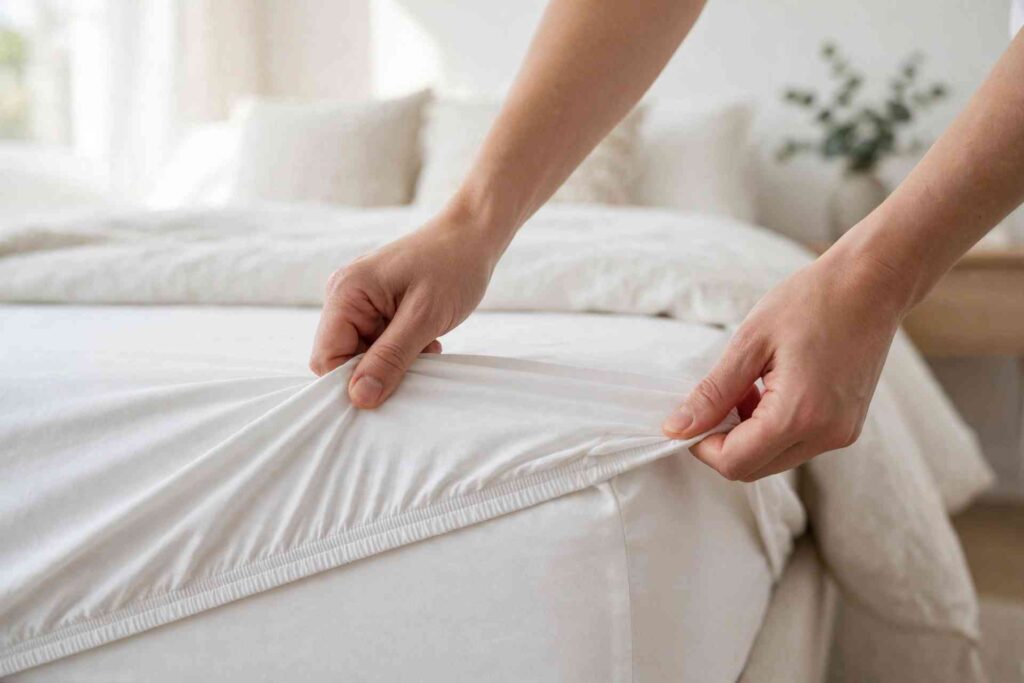
A fitted mattress cover goes on in three steps: strip the bed, anchor the top corners, then stretch the bottom corners into place. The whole job takes about 5 minutes.
Step 1 – Strip the Bed and Check the Mattress
Remove all sheets, blankets, and any old mattress pad. Then vacuum the surface if it looks dusty. A clean mattress means you seal nothing dirty underneath.
Step 2 – Anchor the Top Two Corners
Unfold the cover with the soft side facing up. Most waterproof covers have a quiet fabric top and a plastic-like membrane underneath, but the label gives the final answer. Next, hook the elastic pockets over the two corners at the head of the bed. Pull the cover down the mattress with even tension.
Step 3 – Stretch the Bottom Corners and Smooth the Surface
Pull the bottom corners over one at a time. If a corner pops off, you stretched too far on one side, so release it and pull the opposite corner first. Then run your hand across the surface to flatten wrinkles. Any bunching you leave will press into your skin at night. Some covers include elastic straps or fitted corners to hold tension. Adjust these so the cover stays taut without bunching.
How to Put On a Zippered Mattress Encasement in 5 Steps
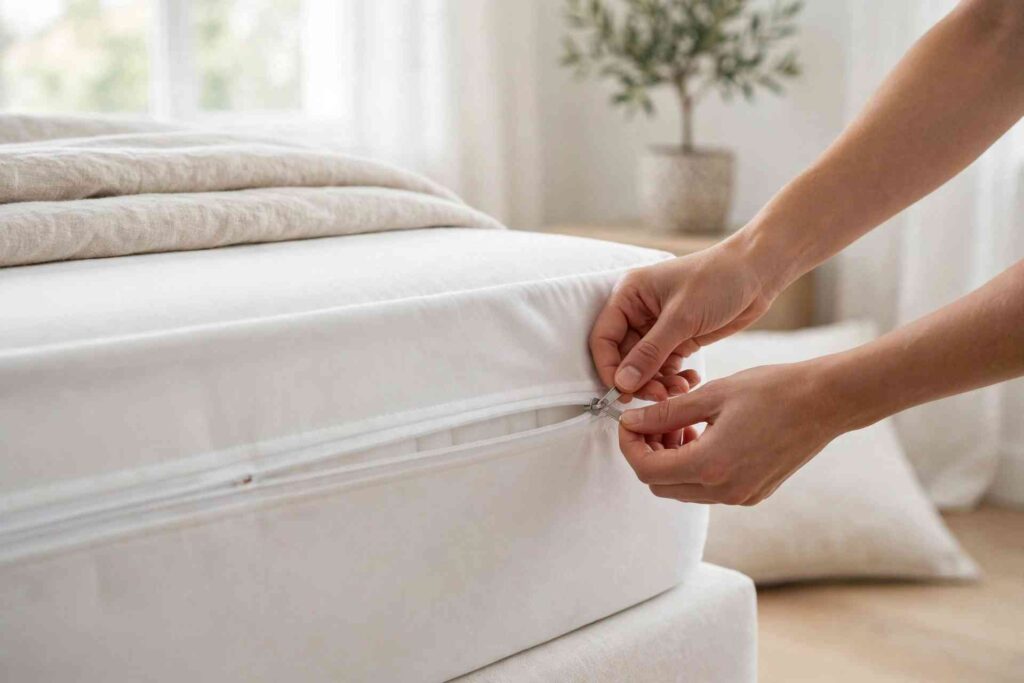
A zippered encasement goes on by sliding the open cover over the mattress from one end, then sealing the zipper without snagging fabric. Plan on 10 to 15 minutes and a helper.
Step 1 – Clear the Bed and Lift the Mattress
Remove all bedding. Then ask your helper to lift one end of the mattress and prop it against the wall or headboard. A tilted mattress gives you room to slide the cover on without dragging it.
Step 2 – Slip the Cover Over the Top Two Corners
Place the encasement over the top two corners of the mattress, then pull it down gradually and carefully. Go slowly, because forcing the fabric causes tears near the seams.
Step 3 – Work the Cover Down the Full Length
Continue pulling the cover toward the open end while your helper steadies the mattress. Keep the zipper track facing outward and away from the mattress fabric. Finally, avoid getting the zippered edge caught on the mattress fabric.
Step 4 – Close the Zipper
Pull the zipper slowly around the full opening. Then stop if it resists. Free any trapped fabric before continuing, since forcing a stuck zipper breaks the teeth.
Step 5 – Check the Fit and Lower the Mattress
Finally, look for loose areas. A properly fitted encasement should not shift or move with regular use. Lower the mattress back onto the frame, then add a fitted sheet and bedding. Put the fitted sheet over the encasement. The sheet goes on top of the barrier, not under it.
Common Problems and How to Fix Them
| Problem | Likely Cause | Solution |
|---|---|---|
| Corners keep popping off | Cover is too small or pulled unevenly | Re-seat the top corners first, then stretch the bottom ones evenly |
| Zipper snags | Mattress fabric caught in the track | Stop, free the fabric, and restart slowly |
| Cover bunches in the middle | Wrinkles trapped during install | Lift the mattress edge and smooth from the center outward |
| Cover feels hot or crinkly | Vinyl cover on a foam mattress | Switch to a stretch-knit cover with a waterproof membrane |
| Sheet slides off | Cover fabric is slippery | Use deep-pocket sheets and tuck the edges firmly |

Memory foam mattresses need a stretchy cover. In contrast, a non-stretch cover can pull apart at the seams or trap heat as the foam compresses and expands during sleep.
How Often to Wash a Mattress Cover After Installing It
Wash a mattress cover every 1-2 months under normal use. However, wash it about every 2-4 weeks if pets sleep on the bed, a young child uses the mattress, or allergies are a concern. Use a gentle cycle with cool or warm water and mild detergent. If you use a dryer, choose the lowest heat setting, since high heat damages the waterproof membrane. Line drying is the safer option.
Why Allergy Sufferers Often Choose Encasements
An encasement blocks dust mite allergens from reaching you. For example, a study of 107 homes in Melbourne, Australia, found asthma-triggering mite allergen levels on non-encased mattresses, while impermeable encasements were associated with lower concentrations. Allergy clinics give the same advice: enclosing the mattress and pillow in mite-proof encasings is the single most important avoidance measure for dust mite allergy.
Frequently Asked Questions About Putting On a Mattress Cover
The terms are often used interchangeably in stores. A mattress protector is a fitted cover over the top and sides. An encasement is a zippered cover that seals all six sides. Check the product description to confirm which you are buying.
Fitted protectors are a one-person job. Strip the bed, hook the top corners, then stretch the bottom corners into place. Zippered encasements are harder alone because the mattress is heavy, so recruit a helper if you can.
The cover goes directly on the mattress, and the fitted sheet goes on top of it. This keeps the sheet washable and the cover protected from daily friction.
Yes. Choose a stretchy fitted cover or a stretch-knit encasement with a waterproof membrane. Rigid vinyl covers trap heat and can tear at the seams as the foam moves.
Pick a cover with deep elastic pockets that match your mattress depth. Seat the top corners first and stretch the bottom corners evenly. Smooth out wrinkles before adding the sheet.
They can, if the product is designed for bed bug protection. An encasement traps existing bed bugs inside the mattress and prevents new ones from entering. Check the product label for bed bug certification before relying on it.
Quick Recap of the Steps
- Identify whether your cover is a fitted protector or a zippered encasement.
- Strip the bed and clear space around the mattress.
- Anchor the top corners first, then work down to the bottom corners or zipper.
- Smooth wrinkles, check the fit, and add the fitted sheet on top.
- Wash the cover every 1-2 months, sooner with pets, kids, or allergies.
References
- National Library of Medicine, PubMed. “Effect of mattress covers and floor coverings on mite allergen concentrations in homes of children with asthma.” https://pubmed.ncbi.nlm.nih.gov/9058687
- CEENTA. “Allergy Avoidance.” https://www.ceenta.com/conditions-and-treatments/allergy-avoidance
- The Brick. “Do You Need a Mattress Protector? What It Does and Why It Matters.” https://www.thebrick.com/blogs/inspiration/do-you-need-a-mattress-protector-what-it-does-and-why-it-matters


Leave a Reply