
[Published: July 27, 2026 | Last updated: July 27, 2026] | 8 min read
TL;DR
- Yes, seat covers can block or delay side airbag deployment if they cover the seam without a proper tear-away path.
- Federal law does not ban seat covers outright, but manufacturers must sell products free of safety defects (NHTSA, 2011).
- A 2023 recall showed exactly what goes wrong: incorrect stitching kept an airbag from deploying as designed (TigerTough, 2023).
- Look for a labeled seam, a tear-away panel, and a fit that matches your seat’s SRS airbag location before you buy.
- The safest move is a cover built for your specific make and model, not a generic “universal fit” listing.
Do Seat Covers Affect Airbags?
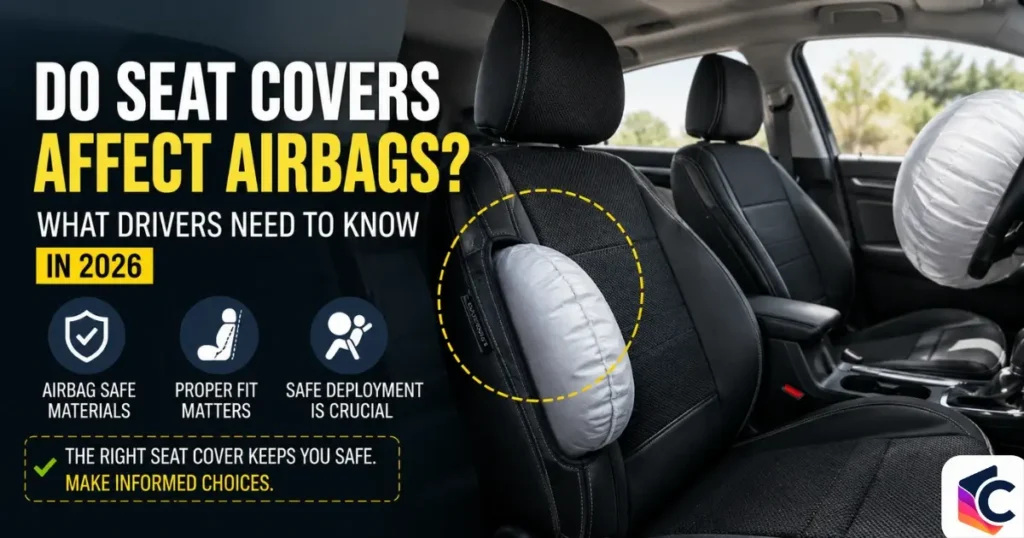
Yes. A seat cover can affect how a side airbag deploys if it covers the seam where the airbag is meant to break through the seat fabric. Most modern front seats house the side airbag inside the outer seatback bolster, and the factory seat cover has a built-in tear seam right at that spot.
If an aftermarket cover doesn’t have a matching seam or tear-away panel in the same location, the airbag can be slowed down, redirected, or blocked entirely during a crash. This isn’t true of every seat cover. Covers designed specifically for airbag-equipped seats are built to let the bag through.
How Side Airbags Are Built Into Seats
The airbag module sits inside the seat’s foam bolster, and the factory upholstery has a pre-cut, reinforced seam directly over it. In a crash, the sensor triggers the inflator, and the bag pushes through that seam in a fraction of a second.
Federal Motor Vehicle Safety Standard (FMVSS) 214 governs side-impact protection and led automakers to widely adopt seat-mounted side airbags after a 2007 update (NHTSA, 2011). That standard applies to the vehicle manufacturer, not to aftermarket seat cover companies.
A generic seat cover made without knowledge of that seam placement has no reason to line up correctly. Even a cover that “fits” the seat shape can sit over the airbag deployment path with no weak point for the bag to push through.
What Happens When a Seat Cover Blocks an Airbag
A blocked or misaligned tear seam changes how the airbag behaves in a crash. Instead of deploying straight toward the occupant’s torso, the bag can be forced to fight through extra material, deploy at an angle, or open with a delay.
The clearest real-world example: in July 2023, TigerTough recalled two seat cover models after finding that stitching meant to secure a breakaway side panel was sewn incorrectly on part of a production run, which could keep the airbag from deploying as intended (TigerTough, 2023). The company notified affected buyers directly and offered a fix, which is the standard process when a safety defect is found in vehicle equipment (NHTSA, 2011).
This kind of failure is not about airbags “not working.” The airbag still fires. The problem is what stands between the airbag and the person it’s supposed to protect.
Are Seat Covers Regulated by Federal Law?
There’s no federal rule that specifically tests or certifies seat covers for airbag compatibility. NHTSA has confirmed in writing that it doesn’t run a certification or testing program for seat covers, and no regulation directly addresses how seat covers interact with side airbags (NHTSA, 2011).
What the law does say: seat cover manufacturers, as makers of motor vehicle equipment, must ensure their products are free of safety-related defects, and must notify buyers and provide a remedy if a defect turns up (NHTSA, 2011). Selling a cover that blocks a federally required airbag path can create liability for the seller, even without a seat-cover-specific rule.
For individual vehicle owners, the picture is different. The “make inoperative” prohibition under federal law applies to manufacturers, dealers, and repair businesses, not to owners modifying their own vehicles (NHTSA, 2008). In plain terms: a shop that installs a seat cover known to block an airbag can face penalties, while an owner who installs the same cover on their own car generally isn’t breaking federal law by doing so. NHTSA still advises against it, and some states place their own restrictions on vehicle modifications (NHTSA, 2011).
How to Check If a Seat Cover Is Airbag-Safe
Before buying, confirm the cover was built for your exact seat, not just a similar body style.
- Find your seat’s SRS label. Look for a tag or embossed marking that reads “SRS AIRBAG” on the outer seat bolster. That’s where the deployment seam sits.
- Match the cover to your make, model, and year. A cover cut for a “universal” fit has no reason to line up with your specific airbag seam.
- Look for a labeled tear seam or open-side panel. Airbag-compatible covers show a marked, stitched break line at the bolster, rather than a solid fabric panel.
- Check the product listing for an explicit airbag compatibility claim, and read return policy terms in case the fit is off.
- Skip thick padding or extra layers over the bolster area. Foam inserts and heavy quilting can add resistance exactly where the airbag needs the least.
Common Mistakes to Avoid With Seat Covers and Airbags
- Buying “one size fits most” covers: These are cut for shape, not for airbag seam placement, and often ignore where the deployment path actually sits.
- Assuming a snug fit is safer: A tighter cover pulled taut across the bolster adds resistance right where the airbag needs to break through cleanly.
- Trusting marketing copy alone: A listing that says “airbag compatible” without showing the seam or citing a fit test isn’t proof. Check photos and buyer questions for the actual construction.
- Skipping the SRS label check: Not every seat has a side airbag. Covering a seat that lacks one changes nothing, but guessing wrong on a seat that does have one is the actual risk.
Frequently Asked Questions About Seat Covers and Airbags
Do all seat covers affect airbags?
No. Only covers that lack a matching tear seam or breakaway panel over the airbag deployment path create a risk. Covers built specifically for airbag-equipped seats include that seam by design.
Is it illegal to install a seat cover that blocks an airbag?
Not for individual vehicle owners under federal law. The “make inoperative” rule applies to manufacturers, dealers, and repair shops, not owners modifying their own cars, though some states add their own restrictions (NHTSA, 2008).
How do I know if my seat has a side airbag?
Check for an “SRS AIRBAG” tag or embossed marking on the seatback bolster, or check your owner’s manual. Not every seat, even in the same vehicle, has one.
Can a seat cover cause an airbag to fail completely?
It’s uncommon for a cover to stop deployment entirely, but it can change the bag’s speed, direction, or timing, which affects how well it protects the occupant in a crash.
What should I do if I already installed a non-certified seat cover?
Check the bolster area against your seat’s SRS label. If the cover has no visible seam or break line over that spot, remove it or replace it with one built for your specific seat.
Are leather seat covers riskier than fabric ones?
Material alone doesn’t determine risk. What matters is whether the cover includes a proper tear seam at the airbag location, regardless of whether it’s leather or fabric.
Key Takeaways
- Side airbags deploy through a built-in seam in the factory seat cover, and aftermarket covers need a matching seam or panel to avoid interfering.
- No federal program certifies seat covers for airbag safety, so the burden falls on buyers to check fit and construction.
- A 2023 recall confirmed this isn’t theoretical: incorrect stitching on a real product line put airbag deployment at risk.
- Match any cover to your exact seat, confirm the SRS label location, and look for a visible tear seam before installing.
Sources:
- NHTSA, “Seat Cushion 214 Interpretation Letter” (2011): https://www.nhtsa.gov/interpretations/11-000699-signature-products-group-seat-cushion-214-interpretation-letter
- NHTSA, “Slip-On Seat Cover Interpretation Letter” (2008): https://www.nhtsa.gov/interpretations/08-002983-slip-seat-cover
- TigerTough, “Seat Cover May Cause Air Bag To Deploy Incorrectly” Recall Notice (2023): https://blog.oemdtc.com/14178/23e058-seat-cover-may-cause-air-bag-to-deploy-incorrectly-tigertough-seat-covers/

Leave a Reply