
TL;DR
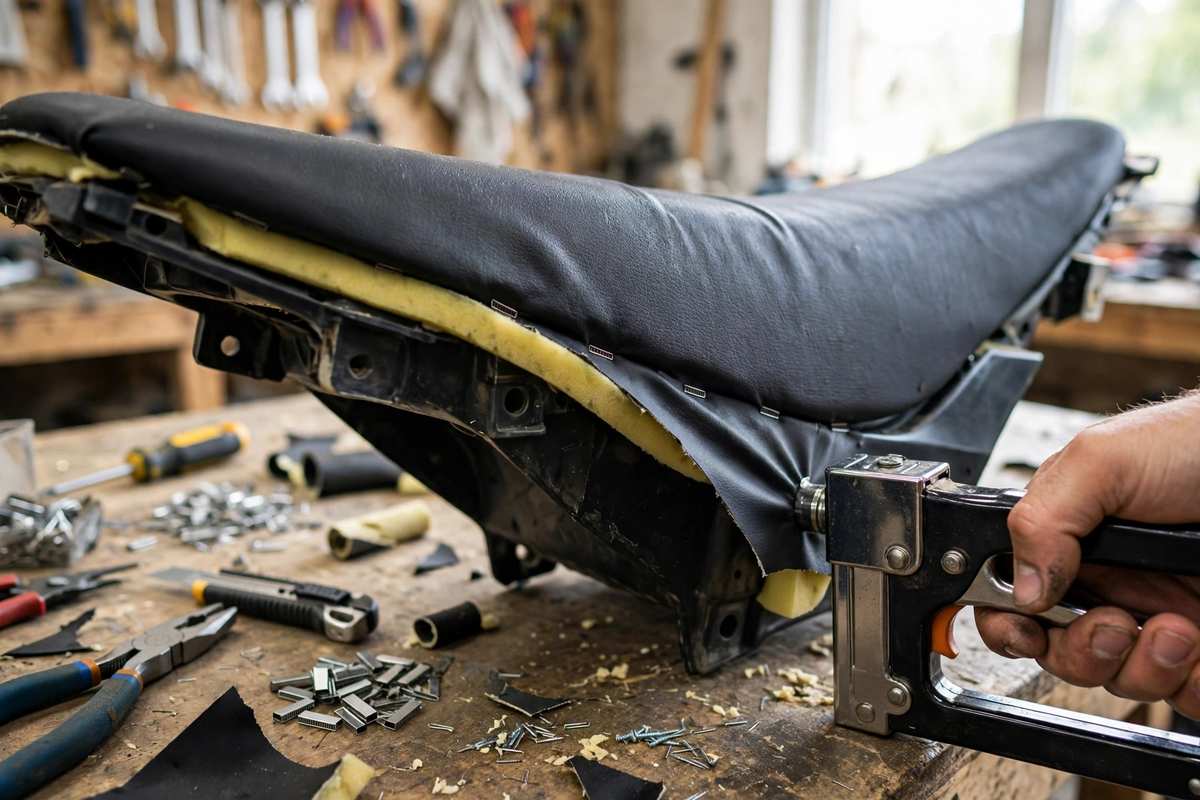
- Use 5/16 inch (8 mm) leg staples with a 3/8 inch crown for most dirt bike seat covers. This is the common T50-style staple that fits most staple guns.
- Firestorm Motorcycles recommends 1/4 inch or 7-10 mm heavy duty staples for seat cover installs (Firestorm Motorcycles, 2026).
- Staples that are too long punch through the cover or foam. Staples that are too short pull out under tension.
- Pull one old staple from your seat first and measure it. Match that length.
- Choose stainless steel staples if you ride in mud or wash the bike often, because they resist rust.
What Size Staples Work Best for a Dirt Bike Seat Cover?
Staples with a 5/16 inch (8 mm) leg and a 3/8 inch crown work for most dirt bike seats. A seat cover only needs to grip a thin plastic or fiberglass base, so shorter staples hold better than long ones. Longer legs risk poking through the foam.
Here is how common staple sizes compare for this job:
| Leg length | Metric | Best use on a dirt bike seat |
|---|---|---|
| 1/4 inch | 6 mm | Thin seat bases, or where longer staples poke through |
| 5/16 inch | 8 mm | The default for most OEM and aftermarket seat bases |
| 3/8 inch | 9.5 mm | Thicker bases, or as a second pass in loose spots |
| 1/2 inch | 12 mm | Too long for most seat bases. Skip unless the base is thick |
Firestorm Motorcycles lists 1/4 inch or 7-10 mm heavy duty staples as the standard for a seat cover job (Firestorm Motorcycles, 2026). A rider replacing a BMW GS seat cover described the correct staples as wide and shallow, about 10 mm by 5 mm (UKGSER community thread, 2026). The 5/16 inch size sits in the middle of both recommendations.
What Is a T50 Staple and Why Do Riders Use It?
A T50 staple is a heavy duty, flat-crown staple with a 3/8 inch crown width. The 5/16 inch T50 version has a 5/16 inch leg length and fits T50-series staple guns (Arrow Fastener, 2026). Arrow calls T50 the best-selling heavy duty staple platform in the world (Arrow Fastener, 2026).
The wide crown matters on a seat. It spreads the holding force across more vinyl, so the cover is less likely to tear at the staple.
Think of the crown as a washer on a screw. A wider washer spreads the load, and a wider crown does the same for the cover material.
Most hardware stores carry T50 staples, which makes them easy to replace mid-project. A pack of 1,250 galvanized 5/16 inch staples costs under $4 at Home Depot (Home Depot, 2026).
How to Check the Right Staple Length for Your Seat
Pull one original staple and measure the leg before you buy anything. CycleGear recommends this step before you remove the rest of the cover, because legs that are too long can punch through the foam or the cover (CycleGear, 2026).
Follow this process:
- Remove the seat from the bike and set it on a clean bench.
- Use a flathead screwdriver and pliers to pull one staple from the old cover.
- Measure the leg length with a ruler or calipers.
- Buy the same length, plus a pack one size shorter and one size longer.
CycleGear also notes that some seats need more than one staple length to hold the cover well, because the base thickness changes from the front to the rear (CycleGear, 2026). Plastic bases on dirt bikes often thicken near the mounting points. Keep a small assortment on hand.
Which Staple Gun Works Best for a Dirt Bike Seat Cover?
An electric or air staple gun works best, because stretching the cover while squeezing a manual stapler is hard on the hands. One rider who used a spring stapler with T50 staples said it made stretching the cover and stapling it difficult, and planned to switch to an electric model (Rocky Mountain ATV/MC customer review, 2026).
Firestorm Motorcycles lists an air, electric, or heavy duty staple gun as the tool for this job (Firestorm Motorcycles, 2026). Pick a gun that matches your staple size. One KLR650 forum member chose an air stapler rated for 5/32 inch to 5/8 inch staples with a 7/16 inch width, which covers every size in the table above (KLR650.net forum, 2026).
Check the gun’s rated staple range before you buy it. A gun that takes only one staple size limits you if the seat base needs two lengths.
Why Stainless Steel Staples Hold Up Better on Dirt Bikes
Stainless steel staples resist rust, and dirt bike seats get wet. Mud, pressure washing, and rain all push moisture into the seat base. Galvanized staples can rust over time and stain the cover from underneath.
One owner recovering a DRZ400 seat wanted staples similar to the OEM type because those seem to hold up without rusting (Garage Journal forum, 2026). Arrow sells a stainless version of the 5/16 inch T50 staple, model 505SS1, at about $12 for 1,000 (Home Depot, 2026). That costs a few dollars more than galvanized and removes one cause of early cover failure.
How to Staple a Dirt Bike Seat Cover Step by Step
Start at the front, then the back, then work along the sides. This order keeps the cover centered and lets you pull out wrinkles as you go. Maxiscoot gives this same order for seat cover replacement (Maxiscoot, 2026). The same front-to-back stapling technique applies to ATV seats — see our guide to ATV seat cover staples.
Step 1: Fit the cover dry. Lay the new cover over the foam and check that it sits straight before any staples go in.
Step 2: Staple the front. Place a staple at the center of the front edge, then work outward in both directions.
Step 3: Pull and staple the rear. Stretch the cover back until it is taut and centered, then staple the rear edge.
Step 4: Staple the sides. Work from front to back on each side, pulling the cover tight before each staple. Firestorm suggests a staple about every 15 mm (Firestorm Motorcycles, 2026).
Step 5: Trim the excess. Cut the extra vinyl with a utility knife, leaving about 10 mm past the staple line.
Buyers of aftermarket covers report that a heat gun helps. Warming the vinyl as you stretch it lets it conform to curved areas, and one buyer had to remove staples and restretch before the cover lay flat (eBay buyer reviews, 2026).
CycleGear also advises placing staples so the crown sits perpendicular to the direction the vinyl is being pulled, which puts more crown area against the load (CycleGear, 2026).
Common Staple Problems and How to Fix Them
Most staple problems come from the wrong length or poor spacing. Use this table to find the cause quickly.
| Problem | Likely cause | Solution |
|---|---|---|
| Staple heads poke above the cover | Staple too long, or gun pressure too low | Switch to a shorter leg and raise air pressure |
| Staple punches through the foam or base | Leg longer than base thickness | Use 1/4 inch or 5/16 inch staples |
| Cover pulls out at an edge | Staples too short or spaced too wide | Use a longer staple or close the spacing to about 15 mm |
| Rust marks on the cover | Galvanized staples in a wet environment | Replace with stainless steel staples |
| Wrinkles near curves | Cover not warmed or stretched evenly | Heat the vinyl, remove staples, and restretch |
Frequently Asked Questions About Dirt Bike Seat Cover Staples
What size staples should I use on a dirt bike seat cover?
Use 5/16 inch (8 mm) T50-style staples with a 3/8 inch crown for most seats. Drop to 1/4 inch if the base is thin, or move up to 3/8 inch for thicker areas. Pull one original staple and match its length.
Can I use a regular office stapler or a light duty staple gun?
No. A seat cover is stretched vinyl under constant tension, and light duty staples bend or pull out. Use a heavy duty staple gun that takes T50-style staples, or an air or electric gun with a similar rating.
Are 1/2 inch staples too long for a dirt bike seat?
They are too long for most seat bases. A 1/2 inch leg can punch through thin plastic or push through the foam and cover. Test one on a scrap area of the base first if you want to use them.
Should I use stainless steel or galvanized staples?
Stainless steel is the better choice for a bike that sees mud and washing. Galvanized staples work and cost less, but they can rust. If you replace covers often, galvanized may be fine.
How far apart should I space the staples?
Space them about 15 mm (roughly 5/8 inch) apart, according to Firestorm Motorcycles (Firestorm Motorcycles, 2026). Close spacing in curved areas helps prevent the cover from lifting.
Do I need to remove the old staples before installing a new cover?
Yes. Old staples left in the base can interfere with the new ones and leave raised spots under the cover. Use a flathead screwdriver and pliers to remove them. One dirt bike rebuild took over an hour just to pull the staples from the old cover (Dirtbikes.com, 2026).
Summary
- Use 5/16 inch (8 mm) T50-style staples with a 3/8 inch crown as the starting size.
- Measure an original staple, and keep a shorter and a longer size on hand.
- Use an air or electric staple gun and choose stainless steel for wet riding.
- Staple front, then back, then sides, with about 15 mm between staples.
- Warm the vinyl with a heat gun on curved areas.
References
- Firestorm Motorcycles. “How to Install a New Seat Cover to Your Motorcycle.”
- CycleGear. “How to Reupholster a Motorcycle Saddle.”
- Arrow Fastener, via Home Depot. “Arrow T50 5/16 in. Leg x 3/8 in. Heavy Duty Staples.”
Use 5/16 inch (8 mm) T50-style staples with a 3/8 inch crown for most seats. Drop to 1/4 inch if the base is thin, or move up to 3/8 inch for thicker areas. Pull one original staple and match its length.
No. A seat cover is stretched vinyl under constant tension, and light duty staples bend or pull out. Use a heavy duty staple gun that takes T50-style staples, or an air or electric gun with a similar rating.
They are too long for most seat bases. A 1/2 inch leg can punch through thin plastic or push through the foam and cover. Test one on a scrap area of the base first if you want to use them.
Stainless steel is the better choice for a bike that sees mud and washing. Galvanized staples work and cost less, but they can rust. If you replace covers often, galvanized may be fine.
Space them about 15 mm (roughly 5/8 inch) apart, according to Firestorm Motorcycles (Firestorm Motorcycles, 2026). Close spacing in curved areas helps prevent the cover from lifting.
Yes. Old staples left in the base can interfere with the new ones and leave raised spots under the cover. Use a flathead screwdriver and pliers to remove them. One dirt bike rebuild took over an hour just to pull the staples from the old cover (Dirtbikes.com, 2026).



Leave a Reply